The world you are born into is the first choice on the birth screen. You pick it before a country is drawn. The four choices are the past, today, the future, and any world. Today’s world keeps today’s statistics through the end of the life. The other three change which year’s numbers the life uses.
The past
A past world uses that year's statistics, including real history such as wars.
The year is not the present. Births, death and income follow that year, and the life can meet wars and other history the operator includes for a past world. It is still a draw: you do not pick the country, and the life still starts at age 0.
Today
Today's world keeps today's statistics through the end of the life.
A life in today’s world keeps today’s statistics until the end. Later years do not swap in a new data release halfway through.
The future
The coming world uses UN and other projections.
The coming world is not a single invented year. The operator calculates it from UN and other projections. Income, population and the length of life follow those projections rather than the latest observed year.
Any world
Any world lets the year of birth fall where the draw places it.
Any world does not lock the birth year to now. The draw places the year, and the life then uses the statistics that belong to that year. It is the widest of the four choices, and the one that refuses a preferred era.
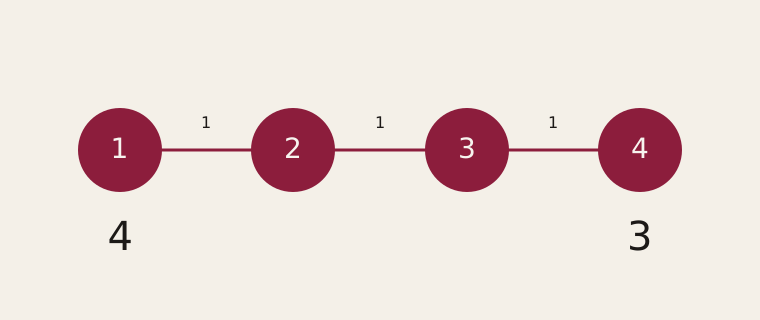
Four worlds in birth-screen order, and the three links between them.
The same four choices
The birth screen offers these four choices in English. Japanese and Korean offer the same four, each in its own language.
English
The past
Today
The future
Any world
What the choice changes
The world decides which statistical year the life is attached to. A past world uses that year’s statistics. Today holds the current ones for the whole life. The future uses projections. Any world lets the year fall where the draw places it.
A past world and the coming world also use historical series: the Maddison Project 2020, UCDP/PRIO and Lee-Lee 2016 sit alongside the UN and World Bank figures used for the present. The 141 birthplaces are the present-day set.
What the choice does not change
You still do not choose the country. One draw follows yearly births. The other follows the people alive now. Either way, life starts at age 0.
The sitting is still about 30 minutes, about 1 hour, or about 1.5 hours. Time still stops at 5, 15, 30, 50 and 70 for one question. Each year still has a focus, and the choices still cover school, work, love, moving abroad and medical care. The world changes the numbers underneath those choices. It does not remove them.
Paying still does not change the life. The keepsake pass adds the House of Past Lives. It does not pick a safer country or a kinder year.
The order on the birth screen
The birth screen lists the four worlds in one order: the past, today, the future, any world. Today is already pressed when the screen opens. You can press any of the four before the country is drawn. They connect in that line — past to today, today to the future, the future to any world. The chart draws those four stops and the three links between them.
Nothing in that line is an upgrade. Today is not a better past, and any world is not a reward. They are four ways to attach a life to a year.