Length of one life sits on the birth screen under the world and the country draw. About 1 hour is already pressed. About 30 min and About 1.5 hours are the other two. The line under the buttons says this is the time it takes to live to that country’s life expectancy. At 1 hour, a year passes in about 40–60 seconds. You can pause or speed up while you live. From the age of 6, This year’s focus is a row of chips. At 5, 15, 30, 50 and 70, time stops and asks one question.
About 30 min
About 30 minutes to live to that country’s life expectancy.
Each year is shorter on the clock than at the one-hour length. The birth certificate still shows the seconds for one year of this life. A life that ends before life expectancy finishes sooner. A life that goes past it keeps the same seconds per year, so the sitting runs longer than the button’s name.
About 1 hour
At 1 hour, a year passes in about 40–60 seconds.
The birth screen opens on this button. The seconds follow the life expectancy of the sex that was drawn. A figure under 60 years is counted as 60 for that division, which is why the slow end of the range is about a minute a year. The age line shows those seconds, then divides them when a faster speed is pressed.
About 1.5 hours
About 1.5 hours to live to that country’s life expectancy.
The same life expectancy produces a longer year than the one-hour button. A year stays between 12 and 120 seconds. With the life expectancies of these 141 birthplaces, that cap is not what moves the number. The life expectancy, and the 60-year floor, are.
The five ages when time stops
This block is called A pause. At 5, 15, 30, 50 and 70, time stops and asks one question. Think about this person’s life and your own together, and leave a line if you like. At the end of the life you can say a few words to this person, which is a separate line from these five. The ✎ Pauses control in the ⋯ menu starts on. Its title is Pause at 5, 15, 30, 50 and 70 to write down a thought. Turn it off and the button reads ✎ Pauses off. What the question would have shown goes into the life record as one line. Tap ✎ Pauses to turn the questions back on.
Age
What the screen does
What the question is about
5
Time stops and asks one question about this life.
What you took for granted at five, or what this five-year-old needs now. The life record also marks the fifth birthday with that country’s chance of dying before age 5.
15
Time stops and asks one question about this life.
What school was to you at fifteen, or how the futures this person can imagine compare with the one you imagined then.
30
Time stops and asks one question about this life.
What is the same in the two lives and what is different, or what this person might be grateful for today.
50
Time stops and asks one question about this life.
What you would talk about if this person were your neighbor, or who has held you steady.
70
Time stops and asks one question about this life.
What this person held dear in one life, or how you want to be remembered.
When the focus chips change
This year’s focus is the panel in the middle of the life. The small label says Change it anytime. Before age 6 there is no chip. The panel says you are still a baby, being raised by your parents, that early moments add up and temperament settles by about five, and that from six you can choose the focus of each year. It also says that stretch can be skipped at 8×. The first time chips are available, a hint says to tap one to choose what this year goes into, and that if you leave it, it is chosen for you. If the stage changes and the chip you had picked is no longer there, the record says the life moved into a new stage and the heart went into the new chip. While looking for work, that line says so. When the old chip comes back, the record can say the heart went into it again.
When
Chips on the panel
In school, below university
Study, Friends & play, Help at home, Exercise, Hobbies
Focus on work, Balance, Family & friends, Health care, Self-improvement, Hobbies
An adult year without that work
Family & friends, Health care, Self-improvement, Hobbies, Rest
65 or retired, and still working (not keeping house)
Focus on work, Family & friends, Health care, Learning and keeping sharp, Hobbies, Faith & service
65 or retired, without that work
Family & friends, Health care, Learning and keeping sharp, Hobbies, Faith & service, Rest
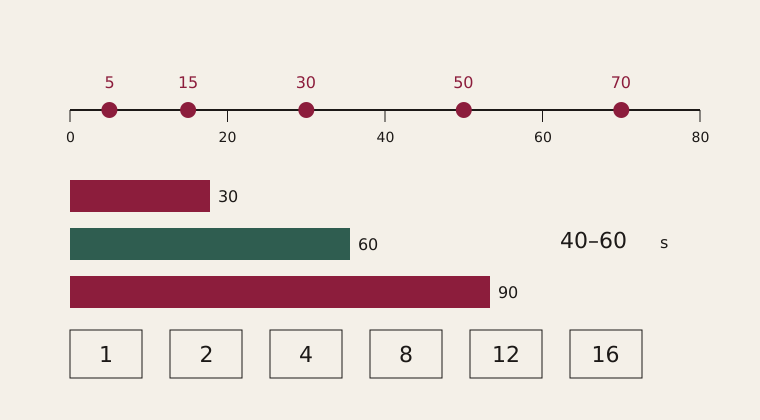
About 30, 60 or 90 minutes to life expectancy. The marks at 5, 15, 30, 50 and 70 are the pauses. The six boxes are the speeds.
One sitting, from the birth screen
Open the birth screen. Leave the world and the country draw as they are, or set them first. Length of one life is the group under those two.
Press About 30 min, leave About 1 hour pressed, or press About 1.5 hours. Read the hint. It is the time to live to that country’s life expectancy, not a promise that the life ends when the clock runs out.
Press Be born. On the birth certificate, read the pace line. Living to life expectancy takes about the length you pressed, and the line gives the seconds for one year. If you close the page, the life is saved in this browser and goes on when you come back in the same browser.
In the bar at the top, use Pause, a speed, or Next decision. Pause reads Resume while time is stopped. The age line shows 1 year ≈ N sec, and N shrinks as the speed rises. Next decision moves ahead to the next choice.
Open the ⋯ menu. On a phone that menu is the ⋯ button. Auto mode lets the decisions be made for you so you can watch. ✎ Pauses starts on. Music and the light or dark control sit in the same menu.
From age 6, tap a chip under This year’s focus, or leave the row and let the life choose. At 5, 15, 30, 50 and 70, answer the question or leave a line. At the end, you can say a few words to this person.
Pause, the six speeds, and Next decision
The time controls are a group in the top bar: Pause, then 1×, 2×, 4×, 8×, 12× and 16×, then Next decision.
1× uses the seconds on the birth certificate. Each higher button divides those seconds, and the age line rounds the result. 8× is the speed the baby panel points at for the years before a focus exists.
Next decision is the jump when you want the next school, work, love, move, or medical choice rather than a faster blur of every year.
Auto mode is not one of the speed buttons. It is in the ⋯ menu, and its title says it lets decisions be made for you so you can watch. The focus chips stay on the page. If you never tap one, the year is chosen for you.
Why one year is not the same length everywhere
The seconds are fixed when the life is drawn. The length you pressed is divided by the life expectancy of the drawn sex. A figure under 60 years is counted as 60. The result is kept between 12 and 120 seconds, then rounded for the certificate and the age line. The rows below apply that rule to the women and men figures for these 141 birthplaces. A played life uses the sex-specific life table, so the certificate can differ by a second from that rounded figure.
At the one-hour length, those figures give a year of 41 to 60 seconds. 18 of the 282 sex-specific figures are under 60 years, and each of those is counted as 60. The shortest combined figure is Nigeria, 54.5 years (women 55.2 · men 53.8). The longest is Japan, 84.7 years (women 87.6 · men 81.6).
The name is the chip. The small line under it is the direction written on the button. Status is four bars from 0 to 100: Health, Happiness, Knowledge, and Relationships. On the narrow bar they shorten to Health, Happy, Know, and Bonds. Income and money are not those bars. They show up in the small line of Focus on work and of Health care. When Knowledge is already 98 or higher, Study, Self-improvement, and Learning and keeping sharp change their small lines to Keep knowledge · Happiness↓, Keep knowledge · Promotion↑, and Keep knowledge and memory. Faith & service is left off the chips while the life is in North Korea, unless that life has already crossed into South Korea.
Chip
Small line
When it can appear
Study
Knowledge↑ Happiness↓
School years, including university and a retake
Friends & play
Relationships↑ Happiness↑
School years, a retake, and under 15 outside school
Help at home
Family↑ Knowledge a little↓
School below university, and under 15 outside school
Exercise
Health↑
School, a retake, under 15 outside school, and military service
Hobbies
Happiness↑ Hobby skill↑
Every stage that has chips, except military service
Part-time job
A little money · Knowledge↓
University, a doctorate, or a retake
Job prep
First job↑ Happiness↓
University or a doctorate
Focus on work
Income↑ Health & Relationships↓
Working years, and from 65 or retirement if the life is still in that work
Balance
A little of everything
Military service, and working years under 65
Family & friends
Relationships↑ Happiness↑
Service, adult years, and from 65 or retirement
Health care
Health↑ Money slightly↓
Adult years, and from 65 or retirement
Self-improvement
Knowledge↑ Promotion↑
Adult years before 65, while the life has not retired
Learning and keeping sharp
Knowledge↑ Memory kept
From 65, or once the life has retired
Faith & service
Relationships↑ Happiness↑
From 65 or retirement, except a life still in North Korea that has not reached South Korea
Rest
Health↑ Happiness↑
An adult year without paid work of that kind, and the same years from 65 or retirement
The question at each pause
Each age asks one of two questions. A few ages offer a suggested line you can keep. At five, the second question depends on the household. When the family is in the poorer part of a birthplace whose income per person is under $15,000, the suggested needs are a full stomach, clean water, and a way to go to school. Otherwise they are a grown-up who plays, a picture book at bedtime, and a yard to run in. The name in the question is the name the life was given.
Age
Question
A line you can leave
5
What was life like for you at five? Think of one thing you took for granted back then.
Dinner on the table every evening. Being taken to a doctor when ill. The swings in the playground nearby.
5
What does this five-year-old need most right now?
A full stomach at dinner, clean water, or a way to go to school. Or a grown-up who plays, a picture book at bedtime, or a yard to run in.
15
What was school to you when you were fifteen?
Where I went to see my friends. Where exams chased me.
15
How different are the futures this person can dream of from the one you dreamed of at fifteen?
I had more roads to choose from. The dreaming was probably much the same.
30
What is the same in this person’s life and yours, and what is different?
We are both tired from work; we live in different places.
30
What might this person be most grateful for today?
Being able to work another day. A healthy family.
50
If this person were your neighbor, what would you like to talk about?
Raising children. What we wanted to do when we were young.
50
Who has held you steady through your life?
A friend who called when things were hard.
70
In this one and only life, what did this person hold most dear?
Evenings with the family.
70
How do you want to be remembered?
Someone easy to be around.
The four bars the chips push
Health affects the risk of dying and whether the life can keep working. Exercise, checkups and looking after yourself raise it. Age lowers it. Happiness is how satisfied this person is. Income, family and friends, health and debt all affect it. Knowledge affects entrance exams, job offers and starting pay. The family’s means and the country’s schools matter more, and above about 70 more of it makes little difference. Relationships are the bonds with family and friends. They affect marriage and its crises, talks with children, the chance of being bullied at school, and loneliness in old age.
The help under Status says higher numbers raise the odds and never decide the outcome. Luck and circumstances play a part, as they do in the statistics the life is attached to. A year of Study can raise Knowledge and lower Happiness, and the birthplace’s schools still sit under that move.
What a focus does not leave behind
Choices change a life, but it is hard to fully escape the statistics of the place you were born. The decisions that come up cover school, work, love, moving abroad and medical care. Today’s world is calculated with today’s statistics, a past world with that year’s, and the coming world with UN and other projections. Income comes from the country’s income distribution, based on the Gini index. Amounts are shown in purchasing-power dollars and in US terms, as they would feel at US prices.
The age at death comes from that country’s life tables by sex. At the fifth birthday the record states the share of children born there who die before age 5, and that this life passed it. At later milestone ages it states the share of the same sex, born the same year in that country, who are still alive. Suicide also happens from the teenage years on, as often as the real statistics say, without showing how or why. The focus chips do not switch those rates off.
From 15, Spend & invest sits beside the focus. It is a separate control. It does not replace the year’s chip, and it does not redraw the country.