Beta, from the English edition to the current build
Update notes
The update list opens on 0.6.88 beta, dated 13 October 2026, and runs back to 0.4.41 beta on 6 October 2026, when 1 in 8 Billion opened in English. There are 221 notes: 79 in the 0.6 series, 89 in 0.5, and 53 in 0.4. The simulation is still in beta.
From 0.6.88 beta back to the English edition
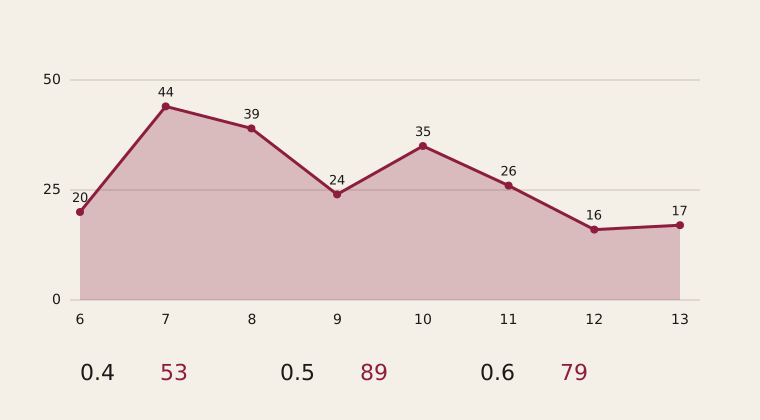
221 notes from 6 to 13 October 2026. Oldest day first, the daily counts are 20, 44, 39, 24, 35, 26, 16 and 17. The series totals are 53 in 0.4, 89 in 0.5 and 79 in 0.6.
Notes by day
The eight days run from the English edition on 6 October 2026 to the current build on 13 October 2026. The counts below run oldest day first, which is the order of the chart.
Newest build first. Each paragraph is one change in that build. Some version numbers have no note.
· 17
0.6.88 beta
A couple who both work now save from both pays. Until now, while both worked, nothing was saved from the partner's pay. Each pay keeps a little less than before, so couples end up better off than people living alone, as they really do.
When moving into a care home, you can choose to sell your home or let it so the rent helps pay for the care. When a home is sold, the record now says how much went into it in all.
A family's means can rise or fall while you grow up: a parent's work finds its feet or a business does well, or a job is lost or a business goes downhill.
Brothers and sisters now share a flat to save on rent, travel with each other's families and hear each other out in hard times. A spouse may take to your hobby too, and a hobby can grow into a band, an exhibition or a club of your own.
A life with cerebral palsy now learns in early childhood which kind it is (spastic, dyskinetic, ataxic or mixed), and its moments follow that kind.
0.6.87 beta
Now in Terms and refunds: you are free to stream 1 in 8 Billion or make videos of the lives you live here without asking, on monetized channels and on TV too. The same goes for films and videos made with Keepsakes.
0.6.86 beta
A life that left North Korea for another country no longer gets parcels from the North or hears its songs in the street. It looks for the food of home in a shop run by people from the North, and news of a brother or sister who stayed behind reaches it months later through a broker, as for a parent.
0.6.84 beta
When you take in a pet, you now choose the small animal too. Besides a dog or a cat, 'Take in a small animal' shows the ones kept where you live (a hamster, a rabbit, a parrot or fish): tap the one you want.
0.6.83 beta
The death record of a life that ended by suicide now has 'Looking back' like any other life. It never names a single reason: it says that health, the hard things met in a life and social conditions such as poverty, loneliness and discrimination are always tangled together, and where help is.
0.6.82 beta
When illness makes you stop work, the record now says so, and a shop or firm you ran is handed on or sold. Lives no longer turn to 'Looking for work' without a word.
At retirement age, choosing 'Look for other work' no longer offers the same work again.
If you moved near work and later change jobs, a line now says the new job is far away again.
While a grown child is in prison, no news comes of their wedding, a home or a promotion; a child who taught or worked for the state does other work after release.
A child who cannot walk now gets a temperament card at two and childhood moments that fit, with no running about or long walks to the well for water.
In the first years of studying or working abroad on your own, you keep up with brothers, sisters and old friends on video calls rather than in person. A child who is not at school no longer reads about speaking another language at school.
Someone with no religion who takes up religious gatherings as a hobby now comes to that faith.
A professional baseball, American football, basketball or ice hockey player in the US or Canada now reaches Major League Baseball, the NFL, the NBA or the NHL at the real rate, and earns that league's pay.
Graduate school alongside work is now open up to 69, and after retiring too. The card about a religious calling now comes up to 44.
In Afghanistan under the Taliban, women cannot start equivalency exams or university study, and the work open to them is as narrow as it really is.
0.6.81 beta
A life that moved to another country or went abroad now has its path drawn on a world map in the record of death. The countries it lived in are numbered in the order it first arrived and joined by a line, and the countries it went to (trips abroad, a pilgrimage, an exchange term, a visit home) are joined by dotted lines.
While you live, the line at the top about who else is living now counts the country you live in now once you have moved abroad. The dots on the first screen's map also show where people are living now.
0.6.80 beta
With a keepsake pass, past lives no longer stop at 10: every one stays in this browser, so you can open it again with 'See again' and make films, albums and memorials from it (for lives after the pass was opened).
When you move abroad or go back home, you can let your home instead of selling it. Letting it from another country costs an agent's fee, and when you come back you move back into it.
Spend money → How to invest now has 'World index (global stocks)'. It also moves with the exchange rate, and depending on the country and the time it may not be available or may cost more in fees.
When a spouse dies first, a child they brought into the marriage may go to live with their other birth parent. The longer you lived together and the older the child, the more often they stay with you.
If loading the data for a past or future world takes long, a 'loading' note appears, and if it takes too long it stops so you can try again or choose today's world.
The privacy policy now says that a browser with a pass keeps the whole record of every past life (from October 13).
0.6.79 beta
If a marriage ends because of a spouse's violence, you receive damages where the law gives them; in Korea, Japan and Taiwan damages also follow a marriage ended by an affair. A divorce never takes more than you have, and after violence your wish to raise the children is almost always granted.
Fixes for blended families: violence from an ended marriage no longer carries over to a new spouse, a child no longer treats their own father or mother as a step-parent when you remarry the same person, and the money a new spouse brings in late life is added to the household.
A large fortune in old age no longer means spending in proportion to it. Retirees with a big pension spend at the prices of the country they live in, and older people living alone spend a little less.
High-school students no longer go into debt for living costs, and well-off families no longer stop school over fees. Where almost everyone goes to high school, as in Japan, failing an entrance exam leads to another school.
Music, dance and art graduates now also get offers as musicians, dancers and painters, and working in that art raises the hobby too. Pay after a Grammy or an Oscar no longer falls back the next year.
Moving abroad on a skilled-worker visa keeps your work or starts you looking for it, and a shop you ran is left in trusted hands for a share of the profits when you move or return.
Civil servants, police and soldiers are no longer laid off in a recession. China's later retirement ages (from 2025) are in, and a member of parliament can prepare to run for president in the fourth year.
Priests, nuns, ministers and monks serve until 75 and remain as emeritus afterwards. In North Korea the first job is assigned by the state. US naturalisation comes only 5 years after a green card (3 if married to a citizen).
Pets you lived with now appear in the family panel and the death record. Male same-sex couples can have a child through surrogacy where it is legal.
Sentences that did not fit a life were fixed, such as electricity reaching the village after you moved to a city, text-message scams before 2010, Red Guards for a child out of school, a child who cannot walk carrying loads, a neighbour's child in a care home, phone calls with family at home, and a wrestler's winning goal.
The card asking whether to buy a car shows how long the commute would take by car. Missed vaccinations and the age of a first time online now differ by household and country, as they really do.
On phones, a double tap no longer zooms the page, and narrow screens no longer cut button labels or the stats. Music can be turned down to 0, and on computers 'Spend money' also opens from under this year's focus.
0.6.78 beta
Among lives born in the UK, Canada and the US, transgender and non-binary lives now come at their real share. Most come to know themselves in their teens, tell a friend and their family, and live as their gender under a name they chose. Family may take time to come round, work and doctors' visits can be hard, and along the way they meet others who have walked the same road. Memorials and shared cards show the life by the gender and the name it lived by.
0.6.77 beta
Drug dependence and sexual violence now happen in adult lives as often as the real statistics say. Neither is ever a choice on a card or shown in detail, and help is always named alongside. Treatment and counselling offer a way back, and these lines never appear on shared cards or memorials.
0.6.76 beta
Roads your family can't afford now show in the card, greyed out: studying abroad, a master's abroad, a business opened with your parents' help. Beside each is why it's closed and about how much you would need saved; with that much saved, you can take it whatever your family's means, and the cost comes out of your savings first.
The temperament named around age five now carries on through the life. A curious child keeps learning a little more each year, an active one stays a little healthier, a warm one keeps a few more people close, and a determined one leaves school less often. Small differences, never a set path.
Your temperament and the gifts that showed in childhood appear on your Identity record. Gifts are set at birth, and only those that showed in childhood are listed.
0.6.75 beta
Send feedback now shows how many characters fit. For anything over 1,200 characters, keep writing in the Google Form once it opens; until now the end of a long message was cut off without a word.
Ideas and feedback can go straight to 'Send feedback' from the bottom of the first screen and from 'Report a problem' too.
0.6.74 beta
Regular check-ups can now find a cancer early. With a yearly check-up, a cancer that screening can catch, such as stomach, colorectal or breast cancer, is sometimes found early and cured. A life that kept up its check-ups and still dies of cancer now says why it came too late: a cancer check-ups rarely find, one that grew fast between two check-ups, or one that had already spread when it was found. Lives in Korea, Japan and Taiwan, where the country screens adults, read the same.
0.6.73 beta
Some lives now begin without their birth being registered, at the real rate for each place. The birth is often registered later, for school or for an identity card; until then, working or studying abroad is not possible.
Lives that never got enough schooling to read and write now come at each country's real rate, and some learn later, from a child at school or at a literacy class.
In the US, the UK, Germany, Italy and Belgium, losing one's home and staying in shelters now happens at the real rate. Most find a home again with housing help or work.
People from poorer countries who go abroad to work may borrow to pay the recruitment fee, and now and then an employer holds back their passport and wages. Embassies and support groups help them get away.
0.6.72 beta
Lives now go on after cancer and strokes. Until now a cancer was found only when it was about to end a life; now people who are diagnosed, finish treatment and return to everyday life appear at their real share. Some lives also have a stroke and learn to walk again in rehabilitation, or live on with its lasting effects.
Miscarriages while hoping for a baby, and babies born early who pull through, now come at their real rates.
0.6.69 beta
'An economic crisis with soaring prices', in countries where such crises keep coming back, is no longer a gamble. Money in the bank shrinks by that year's prices. Changing it into dollars or gold loses only what fell before the change and keeps it safe in later crises, for a little less interest in ordinary years. Money in shares or a home loses less, and a life with little saved meets the crisis in the story, without a choice to make.
· 16
0.6.68 beta
More ways to decorate a room in the House of Past Lives: a photo wall that hangs three moments of that life in frames, things of a time such as a mother-of-pearl wardrobe, a coal-briquette stove, a rotary phone and a cassette radio, and the seasons through the window, from autumn leaves and a sunset to a full moon and fireflies on a summer night. When you pick a thing, those of that life's own time come first.
0.6.66 beta
After a divorce from a spouse who brought children, you now choose how things go with those children: stay in touch, leave it up to them, or let it fade. The tie goes on more often after long years together, with a half-brother or -sister between you, and where you were close. A child you are no longer in touch with is shown that way in the family panel and the record of your life.
0.6.65 beta
Time with a pet now shows in the record: walks with the dog, being greeted at the door, the cat that owned the sunny window. A few such moments come while you live together, and after the animal is gone, a line of missing it.
0.6.64 beta
After scaling back a small factory or shop in a bad year, the 'Hire your first employee?' card no longer comes straight back. It stays away for about three years after you let staff go, and when it returns it asks 'Hire someone again?'. If you chose to run it alone, it is asked only now and then for some years.
0.6.63 beta
Autistic lives without an intellectual disability are now closer to real life. Some started talking late and some when other children did. It may come to light in early childhood, at school, in the teens or only as an adult, and later for women more often. A life that grew up undiagnosed may learn it from an assessment as an adult. A child who started talking on time can now be the one asking 'why?' all day.
0.6.62 beta
Born into a country's richest 1% or 0.1% of families, you now mostly finish school even in poor countries. Before, these families counted like the rest of the richest fifth, so in Niger three in ten children of the top 1% never went to school.
Grown children with a degree seldom end up in factory, farm or driving work now. They more often do work that fits their degree.
The more you know, the better your first job and first pay. Graduates who know more more often get work that fits their degree, and pay in working life spreads with knowledge as it does in real studies (Hanushek et al. 2015).
0.6.61 beta
The privacy policy now covers classroom mode, which opens from a separate link we give to teachers who want to use 1 in 8 Billion in class. In classroom mode every feature that keeps personal information is off, and so are payments; only anonymous statistics that identify no one are sent. The terms add the same from October 19.
0.6.60 beta
A life that has done well sometimes gets asked, past 45, whether to set up a scholarship back home. You can pay a few students' school costs every year, give the school one large gift, or let it pass for now. A scholarship goes out every year as 'Scholarship back home', pauses in a tight year and starts again after. Over the years word comes back: whether the first students finished school, and what one of them went on to do. How many finish follows real scholarship studies, and not all of them do. A will can leave part of the estate to it, and the life's record says how many finished school with its help.
0.6.58 beta
The card to try for the work you dreamed of now shows what that work would pay at the start, and how much more or less that is than now. Years in related work count in part, so an experienced engineer moving into software is not paid like a graduate.
The majors card shows the fields most people really study (business, engineering, nursing, education and so on) more often, and always the field that leads to your childhood dream. With very high knowledge you almost always get into crowded fields like law or computer science.
Your parents' means follow you more as they do in life. A well-off family puts money toward your first business (a very rich one pays for all of it) and sends living money while you look for work. A very rich family passes part of its wealth to you early. Children of very rich families in rich countries can choose to study abroad too.
Starting a business, a shop is now a particular one: a convenience store, a clothes shop, a flower shop, a café, a bakery and more. If you have driven or delivered for a living you can set up a haulage business, and if you have worked in building, a home repair and renovation business. The card offers four kinds instead of three.
The card asking whether to grow your business no longer comes rarely and by luck: it comes often once the business has done well for a few years. In a bad year you can choose to scale down and hold on.
Office, sales and floor workers without a degree rise to department head or manager more often, closer to real life.
0.6.57 beta
When a parent runs a business, its size now shows too. Most are shops or places where a few people work; now and then it is a small company with a few dozen staff or a mid-sized one of around a hundred, and very rarely a family that holds a large company. The birth certificate and the family panel show it with the number of employees, and taking over the family business means running a company of that size. The shares follow real business statistics and what the richest families own.
0.6.56 beta
Lives past 80 that end with heart disease, a stroke, dementia or kidney disease sometimes end quietly in sleep, and the life record, the story and the last moments say so. The cause and its odds are unchanged.
With automatic decisions on, tapping the note box in a pause now stops the countdown. Before, it only stopped once you started typing, so on a phone the pause could move on while you were still thinking. At 16× a pause no longer waits half as long.
0.6.55 beta
A life with autism or an intellectual disability that needs a good deal of support now lives within a household its family runs. The family it lives with covers its living costs, wedding and funeral gifts, and the parents' hospital and funeral bills, so such a life no longer runs up debts or 'can't sleep for debt'.
Such a record no longer has nights talking with old friends until dawn, late phone calls, minding the neighbours' children or a new best friend every year. Instead, a child from the neighbourhood comes over to play beside you, or you sit quietly by someone in the family who is ill.
A child whose speech came late (autistic children too) no longer 'asked why dozens of times a day' or 'talked very well'.
0.6.54 beta
Fixed 'Raise the children again' after a divorce showing only '[object Object]'. Remarrying a former spouse brings home the children who lived with them, and that person no longer 'writes again' as a former spouse. Moving abroad leaves a child who lives with the other parent in their country.
Leaving an open or night university no longer says 'again in 95 years': you can enrol again two years later. A home, car or motorbike bought again after selling can be sold again. Homes you let can be sold at any age, and without a home of your own you can move into one of them.
Going without when no one would lend no longer wiped out a large debt in one year: about a third of the year's pay can be cut, and the rest stays owed. A working couple in debt pays it down from both pays. The debt card no longer comes once the debt is gone.
Children who are not at school no longer meet classmates, school lunches or admission forms. Where school is compulsory, every child starts school.
Someone naturalised after coming from abroad becomes a member of parliament rarely, as in reality, and does not run for president where the head of state must be born a citizen. Guest workers on visas such as Korea's employment permit do only the work the visa allows.
Small fixes: a full set of 10 scenes now says so at the bottom of the screen; no hobby is called '{sport}'; a wheelchair user's sports are wheelchair basketball, table tennis and the like; Hindu temple priests come mostly from Brahmin families; a spouse's job loss depends on their work; no YouTuber dream without electricity; and more.
0.6.53 beta
Fixed lives with an intellectual disability ending by suicide far more often than they do in reality. People with an intellectual disability die by suicide at about half the rate of others (Lindstedt et al. 2025); the illnesses that shorten their lives were wrongly raising that risk too.
0.6.52 beta
On the death record's looking back, a life that looked after family and friends for many years now gets a line with those years and the people who stayed close, whether the dinners, treats, pocket money and trips were chosen by hand or left to a switch.
0.6.51 beta
The income of a life that runs a business now follows the business: how long it has been going and how the year went. It no longer slips after 55 like an employee's pay, good and bad years differ more than a wage does, and a firm with staff loses less as its owner grows old.
· 26
0.6.50 beta
Help lines now follow where you are. In the UK and Ireland you see Samaritans (116 123), in Australia Lifeline (13 11 14), in New Zealand 1737, in India Tele-MANAS (14416), in Canada and the US 988, and the matching lines for young people, for violence at home, for alcohol and for gambling. Elsewhere, findahelpline.com. Your location is worked out on your device from its time zone and is never sent anywhere.
Hundreds of English sentences were read again and rewritten: no more 'your mother's father', lines that slipped into 'I', 'registered the marriage', entrance exams where people simply apply, or the cash condolence gifts of East Asia given to every life. Words about caste, adoption, Indigenous peoples, disability and faith were checked with a sensitivity read.
Couples who lived together before marrying now count their wedding anniversaries from the wedding. A friend who has died no longer calls the next year, and a former spouse never comes back as 'your friend'.
People from rich countries like the US and the UK who get a chance to work abroad now go on a working holiday visa or with an employer's sponsorship, never through a smuggler.
Black South African families now have South African names (Zulu, Xhosa, Sotho, Tswana and more) instead of names from neighbouring countries. Black lives in Brazil and the US are no longer asked 'where are you really from'.
Smaller fixes: the first-pay gift comes only once, adoption is not suggested in the year a baby is born, and a life that ended while its children were small 'had' them rather than 'raised' them.
0.6.49 beta
Lives with autism or an intellectual disability now come at their real rates: about 1 person in 127 is autistic, and about 2% of the world's children have an intellectual disability. The family notices when words or first steps come late, and where a clinic is within reach there is a diagnosis.
A life that needs little support chooses every card as before. A life that needs a good deal of support has its cards headed 'Decided with family', with only the roads open to it (a special school, a sheltered workshop, a day centre). A life that needs a great deal of support gets no big cards, and chooses its days, small choices, pastimes and pets itself.
The disability itself never costs happiness; teasing and being left out do. When the parents are gone, life goes on in a brother's or sister's home or a group home. Your own children can be born autistic or with an intellectual disability at the same rates, and their school, work and home follow their own lives.
0.6.48 beta
Rohingya lives are now part of the simulation. You may be born in Myanmar's Rakhine State or in the camps of Cox's Bazar in Bangladesh: a life without a nationality.
The flights of 1978, 1991-92, 2017 and since 2024, the camps' learning centres and food rations, the boats across the sea and resettlement in a third country come at the sizes the records give.
0.6.47 beta
In the US, the UK, Australia, New Zealand, Korea and Japan, some children now grow up for a while away from home, with relatives, a foster family or in a children's home, as often as the real figures say (about 1 child in 20 in the US).
Many go home after a year or two; some are adopted by their foster family or relatives, or grow up with a guardian; some leave care at eighteen and stand on their own. The reasons are only the ones the data names, such as a parent's illness or a home that could not cope, and the parents are never blamed.
This part of a life stays in its own record and ID card, and never appears on share cards or in the last moments.
0.6.46 beta
Sharing a life now has a box for one line of your own: how it felt to live it. What you write opens the post, and the box shows an example drawn from that life.
The post itself now differs from life to life. It carries what tells that life best: a childhood dream and the last job, the years with a partner, grandchildren, the countries lived in, the happiest year, what family said at the funeral, or a moment you starred. The closing question changes too.
When you post to X, the text is shortened to fit X's limit.
0.6.43 beta
To keep your records safe, the server's records now have copies, so keepsake passes, memorials and shared lives can be brought back after a failure or a mistake. From October 18 memorials and shared lives are copied too, so something you delete or take down stays in a copy for up to 30 days before it is gone. The privacy policy says so.
0.6.42 beta
A life that comes from North Korea and reaches the South now gets the support the real system gives: a settlement grant by household size, a public rental flat whose deposit the state pays, an employment bonus or a matched savings account once in work, five years of medical aid, and university tuition (for the children who came along too).
The broker still has to be paid, and since the border closed in 2020 the road costs more. Living on low rent, some save little by little and buy a home after many years of work.
0.6.41 beta
In the past world, history now reaches your own place in it. A pupil in China in 1966 is asked by classmates in Red Guard armbands to denounce the form teacher: join them, keep out of it, or secretly help the teacher. Parents who taught or studied, or whose family had a 'bad class background', are put before struggle sessions, and are cleared only after 1978.
A university student in Korea in 1974-1987 faces the protests on campus. Leading them can mean jail and expulsion, and in the early 1980s being sent to the army. It goes on to the 1984 readmissions, the streets of June 1987 and, years later, recognition as part of the democracy movement. A life in Gwangju in 1980 lives through that May.
Choices of their own also come to students in China in the spring of 1989, to students, workers and teachers in Argentina in 1976-1979 and Chile in 1973-1977, and to the educated in Cambodia in 1975-1976. What follows comes at the rates found in the records and research of those years, and exiles find the way home open once democracy returns.
Detentions after Turkey's 1980 coup and Czechoslovakia's purges of 1970 are in the record too. A child of purged parents finds university hard to get into until 1989.
0.6.40 beta
You can now be born into a Uyghur or Tibetan family in China. Uyghurs are mostly born in southern Xinjiang (Kashgar, Hotan, Aksu), Tibetans in the Tibet Autonomous Region, Qinghai and Sichuan, and their names come from their own languages.
Gaps in schooling, lifespan and means go as far as China's census and statistical yearbooks count. What rests on UN reports and research, such as Xinjiang in 2017-2019, the fall in births and Tibet's boarding schools, appears only as lines in the record, with their sources and the Chinese government's own account.
0.6.39 beta
Muslim and Christian families in India now have a caste category too. About 41% of Muslims belong to the Other Backward Classes and share the places reserved for them; gaps in means and university go only as far as India's government surveys measure.
Dalit families who are Christian or Muslim are not recognised as Scheduled Castes under Indian law, so they get no reserved places. What such a life meets, and what the community gives, is told in the record.
About a third of India's Christians are born into Scheduled Tribes, as in the real figures.
In Nepal, Janajati families are born into their own people (Magar, Tharu, Tamang, Newar, Rai, Gurung, Limbu, Sherpa and others), and Madhesi families speak a language of the Terai such as Maithili or Bhojpuri. How many speak their own language at home follows Nepal's 2021 census.
0.6.38 beta
Lives that break the law now appear at about their real share: 'A night of drinking', where you choose whether to drive home, a fight over drinks, a teenage mistake, a hungry year. Most end in a fine or a suspended sentence, told with the person who was hurt, the cost, the apology and the way back. Crime still pays nothing.
Someone in your family can go to prison: a parent while you are a child, a brother or sister, a grown son or daughter. There are visits and letters, and a choice about how to welcome them home. Very rarely, a life goes to prison for something it did not do, and waits for a retrial.
A criminal record fades with the years. Its effect on jobs, public posts and visas lasts for a set time, as in real life, and longer after prison than after a fine.
More households own a car in countries like Brazil and Mexico, as in real life: the price is now that of the used or small cars most people there buy.
0.6.37 beta
Shares in the past world now move as that year's real market did. The US (from 1950), Japan (from 1960) and Korea (from 1980) follow each year's real return after inflation; other countries follow the world market's year. Korean shares that halved in 1997 leap again in 1998-1999.
More economic events in the past world: Korea's 'three lows' boom, the Daewoo collapse and tech bubble of 2000, the 2003 credit card crisis, the 2021 borrowing frenzy, the 2022 rate rises, the 2022 global inflation, crises in Brazil, Russia, Türkiye, Argentina, Egypt, Nigeria, Pakistan, Ghana and Iran, and India's banknote withdrawal. Home prices in Korea and the US also rise and fall close to the real years.
Not everyone loses in a crisis. In 1998, just after the IMF bailout, Korean deposit rates soared: those holding cash saw it grow with interest, and those in debt were crushed by it. In a year when shares crash, some say it is the time to buy and others that prices will fall further; what to do then is yours to choose under 'Ways of living' in the spending sheet.
Today's world now has its ups and downs too. Recessions and financial crises come as often as history shows, and in those years jobs are lost and share and home prices fall. Over a long time the averages stay as today's statistics, so a life depends on when it meets those years. The world to come works the same way now, which fixes shares' long-run average falling to almost nothing because of crises.
Recent limits on studying abroad are in. From 2025 US student visas became harder to get and fewer new students arrived, and from 2026 nationals of the 38 countries under US entry restrictions cannot go to study in the US. Canada has capped the number of students from abroad since 2024.
Big yearly swings in your shares are noted in the record only every few years, except the very largest.
0.6.36 beta
Suicide now happens from the teenage years on, as often as the real statistics say. About 720,000 people die by suicide each year, and until now those deaths were shared out among other causes. They are one in 8 billion too.
It is never a decision or a card: it comes like other deaths, by country, age and sex. How, where and why are never shown, and the record never gives a reason. It is a little more likely through a hard time of the mind carried alone, out of work, under heavy debt or after losing someone close, and less likely with someone to talk to or with help. Most hard times still end in recovery.
It never happens before the age of ten, to the child or in the family. In Korea nearly half of teenagers' deaths are suicides, so teenage lives follow the real statistics too. When someone close dies by suicide, the grief of those left behind follows, with the words that it is no one's fault and where support is.
Now and then the record also tells of a friend who went through a time so hard they did not want to live and came through it with help, or of asking someone who seemed to be struggling and staying with them.
Shared cards and texts, link pictures, memorials, films and albums do not name the cause; they only say the life ended. The record of death always shows where help is: in the US and Canada call or text 988, and findahelpline.com lists others. If things feel hard right now, someone will listen.
0.6.35 beta
The first screen opens faster. The page is lighter, and the parts of 'Keep this life' that make videos and albums load after a life ends. The update notes load when you open them.
A few fewer cards. Things whose answer is plain from the family's means, such as a child's school, are decided the way such families usually do, with a line in the record and no card (private or public can be changed under 'Spend'). When relatives ask for money again or a second chronic condition is found, you do what you chose the first time, and the record says what was asked.
From 65 the small everyday choices no longer come, and the choices met along the way are spread over the whole life. The neighbour's child card comes more rarely. The will card comes by itself only where wills are commonly written; elsewhere you can write one under 'Spend'. The lottery card comes only in a year with no other card.
The record after a life is shorter. 'Keep this life' and sharing come right after your farewell, and the children's lives, family and life, money and decisions and what was left open under 'More about this life'. What it can make and the previews show under 'What you can make'.
0.6.34 beta
Moving between countries with free movement, such as in West Africa or Europe, could end with 'the visa was refused' even though the offer said no visa was needed. Now you can always go, and you look for work once you arrive. Moves to and from Burkina Faso, Mali and Niger, which left ECOWAS in 2025, are described as the free movement both sides recognise.
0.6.33 beta
Born in India or Nepal, your family's caste category now shows on the birth certificate and ID card (India: Scheduled Caste, Other Backward Class, General category; Nepal: Dalit, Khas Arya, Janajati, Madhesi). Gaps in means, schooling and lifespan follow the survey data and no more, and discrimination is told only as what that life goes through. Reserved places in universities and public posts, and marriages across castes, happen at their real rates.
A life can now begin with adoption as a baby: at the real rate for the country and the year of birth, to another family in the same country or to a family across the sea. In the past world, in Korea in the 1970s and 1980s about 1 baby in 100 was adopted abroad.
An adopted life may be told as a child, or find out late as an adult. Whether to look for the mother who gave birth is that life's own choice; some meet again, and some never find her.
0.6.32 beta
More ways to keep your money: savings, bonds, a balanced stock-and-bond fund, stocks (an index), a property fund, or picking and trading shares yourself, with returns and swings as in the long-run data. Most people who pick shares and trade often earn less than the index. Moving to another way sells the first, with fees and, depending on the country, tax on the gains.
'Homes to let': buy a home with a loan and collect rent. Lenders' limits and rental yields differ by country, and empty months, upkeep and taxes, buying and selling costs and capital gains tax come close to the real thing. If the debt gets too heavy, you may have to sell quickly and cheaply.
Homes and wealth are closer to real life: when and how often people buy homes follows the data, home loans are paid off on schedule, loans cost less where interest rates have long been low (Korea, Japan), retirees spend their savings little by little, and a home grows older, so its value rises slowly.
Under 'Ways of living' you can take out fuller insurance: premiums every year, much less to pay for hospital care, and a payout to your family if you die before 70.
Someone you broke up with, or a former spouse, may get in touch again. A request to stand surety, a spouse's posting abroad, a call from a father who left, a half-sibling you never knew. If a child raising children alone dies first, you decide who raises the grandchildren.
Where the law allows, children can take the mother's family name ('Ways of living' → Children's family name), and a mother raising her children after a divorce can ask a court to change their name.
Certificates and work courses help a little toward promotion for three years. You can apply to the army, naval or air force academy, and air force officers and pilots are a little more likely to become astronauts.
Professional athletes can be picked for the national team, and coaches who played for it can rise to coach it. Fishers can join a distant-water vessel: more pay, but far from family and dangerous.
Owners can retire handing the running to someone else and keep a share with a dividend; in a future world AI handles orders and stock. A business you ran and homes you let are part of what you leave, and the record shows what it was.
Parents sometimes send a child to private school. Doing the work you dreamt of as a child makes you a little happier while you do it.
On phones the small bar at the top has a 'Spend' button, and the boxes below can fold to their titles. On wide screens 'Family and life' moved to the top right. The music changes a little with the stage of life: childhood, youth, adulthood and old age.
0.6.31 beta
Brothers and sisters can now die too, at the real death rates of their country and time. Those who passed away are listed apart in the family panel, and missing them may show in the record years later.
Your children can be born as twins: about one delivery in 70, one in 35 in sub-Saharan Africa. When a child dies leaving children of their own, the record says who will raise your grandchildren.
Where there is a minimum wage (Korea, Japan, the US, the UK, much of Europe, Chile, Mexico and others), a formal job no longer pays less than it.
Living in a home of your own saves the rent, and a loan secured on your home costs less interest than other debt. Once the loan is paid off, housing takes a smaller share of 'Where the year's income goes'.
Crossing to another country without papers by a risky route means no permit to stay and no formal job. Each year you may be caught and deported, or after some years get permission to stay.
A student from a family that had to flee tries for a scholarship to study abroad instead of family money. Where public universities charge no tuition (Germany, France, the Nordic countries and others), a child's university costs only their living costs.
Turning a switch under On its own on and off no longer fills the record with lines. A switch that cannot run right now says 'on hold for now', and one whose time has passed (courses or job hunting past 60, for example) turns itself off. On phones, the money line above the record shows debt left.
Fixed moments that could not be added when tapped while dressing a film, an album or a memorial. The handwriting in the 10 photos now shows evenly from the first photo to the last.
Small fixes: a baby who lost their mother early no longer says 'Mama' first. A child out of school is not told about a classroom in the lines about their gifts, and teenagers at work no longer beg for lessons. A child living with the other parent no longer has moments at your home. A pro athlete gets no local prize in their own sport, and one who quits as a teenager goes back to school. A second wife now appears in the wedding costs, the will and the death record. Years running your own shop count as experience in that work. Television comes after electricity. The birth certificate's Back to start button no longer runs off a phone screen.
0.6.30 beta
The spending sheet's Ways of living → On its own now has hobby gear and lessons: turn it on and the hobby you chose last gets gear and lessons every year.
With more than one hobby you can choose which one gets them. Lessons add less to a hobby you are already good at, and more with a gift for it.
0.6.29 beta
From October 18, emails to customer service are read and sorted with the AI assistant Claude (Anthropic), which drafts replies; the operator checks every reply and sends it by hand. The privacy policy now says so, along with two more things: feedback is read and sorted with Claude too, and the private development records of what was fixed (GitHub) quote or sum up feedback and emails, leaving out anything that identifies the sender.
0.6.28 beta
Music and dance are now university majors. They appear on the major card for someone who has sung, played or danced since childhood and whose family could pay for the lessons, or who has a rare gift for it; the audition decides.
A dancer's road: dancing since childhood, or a dance degree, can bring a dance company's audition. The years on stage are short, mostly into the thirties. A music degree also opens the musician's road more often.
Applying to an arts high school now names the department: music, dance, fine arts, or theatre and film.
0.6.27 beta
For a problem that needs a reply, "email us" under Send feedback, or "Report a problem" in a keepsake message, starts an email with the version, your device and this device's recent problems already filled in. You can read and delete them before sending.
0.6.26 beta
A life can now drift away from worship while keeping its faith. Leaving the religion one grew up in differs by country as it really does: common in South Korea, rare in India and Israel.
Now and then a life comes to a crossroads of faith: after losing someone close, at university, after long years in a country of another faith, or when a friend asks you along. Turning to another faith or none can upset the family, sometimes for years, and a call of reconciliation may come later. Where leaving a religion is punished, it can be let go only inside.
Studying abroad now offers three countries students from your country really go to (Morocco mostly to France, Nepal to Australia), each with its cost, its language (a year of language study when you don't share one) and how easily graduates stay to work.
After a degree in a rich country, a few look for work in a third country.
0.6.25 beta
Everyone is born with their own grain. A rare gift for learning, sport, drawing, music, working with one's hands or getting along with people shows in the childhood record, and a life that follows it goes a little better. It never shows as a number.
Knowledge now means where you stand among people your age. 100 is rare, and more knowledge keeps helping a little all the way, in admissions, medical school and first jobs. Stop studying and others your age slowly pull ahead.
The more one earns, the larger the share kept rather than spent, as in real household data. The money panel's 'Where a year's income goes' shows taxes and social insurance on their own.
0.6.24 beta
From October 18, when a memorial cannot go up or change, what got in the way (when, why, which version) is kept with your keepsake pass for 30 days, so if you write to customer service we can find the cause without screenshots. The privacy policy says so.
0.6.23 beta
Some lives could not be put up as a memorial because a line of their own record tripped our filter. Fixed.
· 35
0.6.22 beta
Choosing to keep working no longer works forever: with age, work ends for reasons one does not choose (health, a spouse to look after, a contract not renewed), and the record says which. Police, soldiers and civil servants retire at the age the law sets.
A retired person elected to a local council now draws a councillor's allowance, and the status line shows the seat.
Turning people down again and again makes love come round less often. Sports rankings fit the age, grandchildren's crooked letters come while they are small, and a child's first-pay gift comes when they start work.
A stolen bicycle is gone from what you own and can be bought again. A home lost in flight no longer blocks buying one in the new country. Muslims rarely get the drinking card.
No holidays abroad from North Korea or the closed countries of the past (South Korea limited them by age until 1989).
Naturalising in Japan while married to a Japanese spouse takes the spouse's family name. A professional practice's title stays in the record after retiring. Art and media graduates are offered design work more often.
Adults in their twenties to forties with upper secondary school can now choose an open university from the spending sheet.
With 12 stars already set, starring a new moment opens the list of stars so one can be let go. Past lives keep up to 500 rows, shown 30 more at a time. The death record has '← First screen' at the top too.
At high speed, a life stops once at age six to choose the year's focus (on devices that have picked a focus before). The names line under the picture lines up with its caption.
0.6.21 beta
A marriage agency or matchmaker now introduces up to three people, one at a time. If it does not feel right, the next person comes a few months later, and sometimes it is the other side who says no. While you are seeing someone, the next introduction waits.
0.6.20 beta
You can give pocket money to your grown children and grandchildren (Spend & invest), choosing who gets it, or let it go out every year under Ways of living. Money brings people only a little closer, more so for a child going through a hard time. While you are giving to a child, that child sends you nothing; the years you helped come back a little in the help they give later.
0.6.19 beta
After a divorce you can ask to bring back the children who live with your former partner (Spend & invest). If you agree together they come at once; if not, a court decides what is best for the child. The older and closer the child, the more their own wish counts, and now and then a teenager asks to come on their own.
When you go home with a spouse you met abroad, they do not always come. Most do, but some stay a year or two to wind up their work first, and some couples decide to live each in their own country and part.
There are days out with the children now: an indoor play café, the aquarium, the zoo, a stream. Grown children may ask you to mind the grandchildren, children living at home may put part of their pay toward the household, and a child may leave university to find their own way.
0.6.18 beta
The life film, trailer, photos, life album and memorial, and the last moments, now show what really happened in that life: the wedding, the day a child was born, graduation, a day at work, a trip, a hospital room, a goodbye in the rain. Each moment has its own place, and people dress and move for it.
The last moments now pick the big events of a life first (a wedding, a child, graduation, a first job, a home, a trip). A scene you choose in 'Dress it' shows the very moment you chose.
0.6.17 beta
'Watch with sound' on the after-the-credits clip in memorials and the House of Past Lives now plays clearly on phones, even with an iPhone on silent, as does any sound you start with a tap: film and teaser previews, and '♪ Listen' when dressing a keepsake.
The background music can now be heard on phone speakers: its low chords carry a voice an octave higher, and it is a little louder.
Four new days for the after-the-credits clip: hide-and-seek with a child or grandchild, a summer night against one mosquito, the morning after a lifetime of work, and a day in the first year in a new country.
A life is less likely to get the same day as the last few lives lived on this device. A first video call with a grandchild now comes only to the generation for whom it really was the first.
0.6.16 beta
The questions in each pause now ask by the person's name, and the note box shows an example that fits the life.
Around six or seven, a child says what they want to be when they grow up. That childhood dream comes back later in 'A long-held dream' and in trying for work you've wanted to do; the card shows which work is a childhood dream or tied to a hobby, your degree or a parent's work.
The retirement card now shows your pension, what your grown children could send and how many years your savings would last. You can also cut down to part-time: about half the pay, easier on the body.
Passing the high school equivalency exam tells you that university studies are open to you. Past 50, 'Spend & invest' lets you enroll at an open university until 75; about half finish.
When someone much older or younger comes along, the card tells you the usual age gap between spouses in that country.
You can look into starting a business until 75.
In your first life, you are told once that you can tap the chips to choose this year's focus. When knowledge is full, the study chips say so.
0.6.15 beta
A child's health now follows what the whole household has, not only the mother's own pay. Children of well-off homes fall ill and die less often, and hunger or diarrhoea take children mostly in poor homes. Deaths of children over five are now as rare as they really are.
The card about a child falling seriously ill now comes for the youngest child.
How many people finish each stage of school now follows UNESCO's measured rates in each country. In Nigeria, for example, about 69% finish high school; in Pakistan, about 27%.
If you cannot get into high school, you are now told why: fees, the leaving exam, no school nearby, too few places.
0.6.14 beta
Moving abroad no longer carries on the work you did at home. Your own land, herd, fishing boat, shop and posts in the state stay behind, and if you did not go with a job arranged you start by looking for work.
The countries you lived in now include going home, in order (for example Madagascar → France → Madagascar). Back in a cheaper home country on a pension, you live at its cost of living and save the rest.
A baby is no longer left with a grandparent who still goes out to work. Under China's one-child policy, a child born after losing the first no longer brings a fine.
Where public health care covers hospital bills (the UK, Canada and others), you no longer pay your parents' hospital bills. Elsewhere you share them with your brothers and sisters.
After a divorce, children who live with the other parent show in the picture's caption, such as 'two children live with their mother'. In a life with more than one partner, each child on the family panel shows their mother's or father's name, and a late spouse stays there after a remarriage. You can also go on trips with your grown children.
Doctors and lawyers who open a clinic or a law office keep building their years as doctors and lawyers. University and graduate degree holders are seldom offered farming, herding or fishing, unless they have done it before. Teaching a child football now shows clumsy footwork, reading a halting voice, and so on for each pastime.
Someone who has just defected or fled no longer 'meets old friends again'. Children living abroad no longer drop by the care home every weekend or take over your shop. A war that began and ended in the same year is no longer told ending and then beginning.
The custody card quotes Korea's, Japan's and the US's own figures. On a computer, number keys 1 to 6 change the speed, and the birth certificate in an app added to the home screen has 'Back to start'.
0.6.13 beta
Each person now has their own skin tone, from where they were born and where their family comes from. The same person looks the same everywhere: in the life pictures, memorials, bonus clips and link pictures.
In South Africa, Black, Coloured, White and Indian families are born at their real shares, with gaps in family means, schooling and lifespan close to the real ones. Black families raise their children in their own language, such as Zulu or Xhosa. Born in a past year, you live through the apartheid years.
A child who has played Go or chess seriously since an early age may, rarely, get the chance to try to turn professional or go for a title. As in real life it is a very narrow road (Korea admits fifteen to twenty new Go professionals a year).
A grown child who loves someone of the same sex may come and tell you. Every way you can answer is a way of taking them in.
If you live abroad, 'Look into going home' is now among the moving options in 'Spend & invest'. The choice to go home comes the next year.
'Ways of living → On its own' in 'Spend & invest' now has 'Decide for each child': with it on, university fees and wedding costs are asked again for each child instead of going the way you decided for the first.
In your twenties and thirties, if you lose your job, fall into debt or have just separated, you can move back in with your parents. Your living costs go down.
0.6.12 beta
A life that ends with a long illness, such as cancer, chronic lung disease, kidney failure or cirrhosis, usually learns of it first. There is time for treatment and for family, and now and then a recovery. Going from 'nothing wrong' at a check-up straight to a sudden end the next year happens far less.
If you keep working past seventy, you work fewer hours and earn less. When your health gives out, you stop working. Marriages made late in life end in divorce less often.
Even in a poor country, someone who earns well for that country can put a little aside. There, investing in property is offered once you have saved enough to buy land or a home.
During military service the army houses and feeds you, so no debts pile up for living costs, and a little of the pay is saved. Career soldiers live in military quarters and pay no rent. Officers from a military academy stay in the forces through their years of obligation, and after conscription, offers to sign on come a little more often.
Airline pilots and cabin crew are mostly hired young. Pilot offers no longer come out of the blue to people in other work, and there are about as many pilots and cabin crew as in reality.
Job offers are now compared with what you actually earn. Fixed a move that kept the old pay, with the same offer coming again and again.
Your brothers and sisters and the old friends still with you come to your funeral. A former spouse stays in the family panel and in the final record, and when you live on your spouse's pay, the money panel shows where that pay stands.
In China and Taiwan you can retake the entrance exam twice too. Lawyers find the way into politics a little more open. When a great-grandchild is born, you hear which grandchild's baby it is.
Fixed: a friend made that year dying the same year as an 'old friend', a friend asking to borrow money when no friends were left, a grandparent or relative raising an orphan captioned as 'father', more older siblings than the mother's age allows, and two of a spouse's children with the same name.
Fixed: a card to move to a city back home while studying abroad, a missed vaccination in Korea because 'the clinic was too far', gym, travel and karaoke offered as hobbies to a seven-year-old, a child living with the other parent after a divorce begging for a dog in your home, and a married child quitting work to move back in. The last moments no longer open with a friend's death that year.
0.6.11 beta
Without a pass the same cards show previews first: the teaser and the scene after the credits from start to end with sound, and three of the photos.
0.6.10 beta
The keep panel is tidier. 'Made for social media' now comes first: the 20-second teaser, the scene after the credits, the photo set and the memorial's link as vertical cards with pictures from that life. Tap one and it is made; a video you made can be watched and posted again from the same card. The film, album, memorial and record book sit below under 'To keep'.
The scene after the credits made on its own now gives its real length, about 20 seconds.
0.6.9 beta
Fixed videos on iPhone that stopped at the end with no word of what came next. When the recording ends you now see 'Almost done' at once, with the video's own picture while it is put together. If the recording does not finish properly, the video is made from what was recorded; if even that fails, you can make it again or make it without sound. When it is done, the 'Post it now' button is right on the screen.
The bonus scene made on its own now opens with a few music-box notes.
0.6.8 beta
Household bills now go to the ledger rather than the story. A relative's funeral gift, a car repair, a rent rise or a broken appliance still costs the same and shows in the money panel, but the life record tells only the first one, or one that leaves you struggling.
Old age now has its own good moments: a grandchild staying the weekend, old friends meeting every month, a former colleague coming to you for advice, the family gathered for your seventieth or eightieth birthday. In real life, stress and worry tend to fall with age, and enjoyment rises again.
A year or two after you lose someone close, the record remembers them: the family gathered on the anniversary, a path you used to walk together, something they always used to say.
In very hot countries, the heat no longer comes up quite so often in the record.
When a life ends, 'Looking back' starts with what the life kept, and the panel on what the life went through shows first the people working on it today.
0.6.7 beta
Very rare moments are now hidden around lives as Easter eggs: finding something for the first time, or living through something that happens once in a lifetime, if that. They happen only as often as they do in the real world, so most lives never meet one. When one comes, the record marks it 'Easter egg', and you can see it again in the record of death.
The first screen now shows only how many people are living a life in this simulation right now. People on the first screen and people whose life has ended are not counted.
0.6.6 beta
In 34 countries you can be born into an ethnic minority, an Indigenous people or a multicultural family, as often as such families are born there. The differences in school, work and lifespan follow each country's statistics. The birth certificate and ID card show your family's roots.
Alongside moments of unfair treatment come the lullabies and old stories in the language of home, the holidays and the strength of a community. Each moment comes at most once in a life.
You can now be born into a royal or an old noble family, as rarely as such families are born. Those lives are told like any other, with no mark of their own.
After marriage a heart may waver. You can draw a line or keep meeting in secret; going on costs lies and money, and if it comes out the marriage and the children's trust are shaken.
After some years abroad, a chance may come to move on to a richer country. Grown children sometimes stay behind.
Marrying someone of another faith follows the laws and customs of the place. A man marrying a Muslim woman is asked whether to convert, and keeping his faith can make the marriage hard to register and the family hard to win.
Losing a spouse young can mean moving back in with your parents.
'Look for someone' now has 'Meet people from other countries'. Men in the countryside or over 35 in Korea, Taiwan and Japan meet through an international marriage agency.
Christians are now Catholic, Protestant, Orthodox or Anglican, and funerals, First Communion and Easter night follow the church.
At the funeral, family members say a few words about the one who died, and the last words are told. No score or verdict.
Tap the picture, or the line under it, to see the names and ages of the people in it.
'Any world' joins the choice of world: it draws the past, today or the future, and in the past the year of birth too.
New work: airline pilots and flight attendants, who can rise to captain and purser.
Siblings' weddings and babies, long-kept hobbies and the temperament seen in childhood now carry on in the story of adult life.
0.6.5 beta
The scene after the credits now follows that life's own record. The day falls on its moments, like the year a baby was born, a tenth wedding anniversary or a sixtieth birthday, and the words name the partner, the child, the grandchild's parent and the pet. Under the last photograph comes one line of what happened after: what the baby of that day grew up to do, how many more years they had with their partner, how many more years a parent was there, all from the life's real record.
0.6.4 beta
The scene after the credits has eleven new days, twenty-four in all: a parent who falls asleep before the baby, a family photo on the self-timer, birthday candles that will not go out, an umbrella turned inside out, the neighbours' goat eating a sleeve, a video call that only shows a forehead, a pigeon after a sandwich, a bike ride with the hand long let go, a huge parcel box, a giant pumpkin and a smoky first dinner.
Its camera now follows the people and jumps closer with a shake at each surprise, fast runners leave speed lines, and the day ends frozen as a photograph with its date stamped in the corner. Each surprise has its own sound, and the tune is fuller.
Keepsakes now have 'Made for social media': a 20-second teaser, the 18-second scene after the credits on its own, and about ten portrait photos of this life's years with handwritten captions, each one tap away. The photos post together as a carousel on Threads or Instagram.
A memorial's room now opens with that life's scene after the credits. It plays once by itself for visitors, and a tap plays it again with sound.
0.6.1 beta
Putting off military service now really brings the call-up back a year later. Before, putting it off could mean never serving, and at an age when it could no longer be put off you enlisted without a word. Where only some are called (Sweden, Norway, Denmark, Thailand and others), only about as many serve as really do.
Career soldiers now reach field rank in about ten years, as in real armies, and a few become generals. They retire in their fifties by rank and draw a pension. A professional athlete who is called up puts the career on hold and goes back to the team after discharge if there are playing years left.
Frequent family dinners and trips together bring you closer to your parents and children. Time spent together fades slowly over the years.
A spouse's pay now follows the real gap between men's and women's earnings: born a woman, you more often have a husband who earns more.
A family that can afford it lets you retake the entrance exam once more (in Korea and Japan up to a fourth try). If your student visa is refused, you can apply to universities at home the same year.
Coming home after years abroad, grown children who were raised and settled there mostly stay in that country.
Money earned abroad no longer inflates your home country's pension. Working past retirement age, you also draw your pension if you paid in for more than ten years.
During China's one-child policy (1980-2015), a child over the allowed number means a social maintenance fee, and a state job may be lost. In past worlds, socialist countries have no private schools and the state pays for university and dormitories. Japan now has its 1986-1990 bubble economy.
No more jobs that do not fit an age, like an 18-year-old professor as a partner. If your well-off family sent you abroad to study, you are no longer asked to send money home. Trying for a dream job, work tied to your studies, hobbies or a parent's work comes first.
After 60 you are no longer asked whether to buy a first car, and in old age you may give up driving and sell the car (handing in the licence in Korea and Japan). Very rarely a life goes past 110. The background music is easier to hear.
0.5.99 beta
High blood pressure and diabetes now come as often as they really do in each country: diabetes is common in Pakistan, Mexico or Egypt, high blood pressure in Eastern Europe. Family history, smoking and drink, what you eat, desk or physical work and how hard you work change the odds.
A condition is not known the moment it starts. It is found at a check-up or a hospital visit, and where doctors are far away many lives go on without knowing. Korea, Japan and Taiwan's national check-ups find it early more often. A check-up may also say your blood pressure or blood sugar is borderline.
'Ways of living' in the spending sheet now has 'Eating': eat like the people around you (the default), less salt with more vegetables and whole grains, or often eat out or order in. Eating with care costs a little more at the shops and these conditions come less often; eating out is easy but costs more.
After a diagnosis you can choose to take the medicine and change how you eat and move.
0.5.98 beta
Keepsakes now include the life record book: one file that binds each year's work and income, net worth, happiness and health, the family, the decisions made and what came of them, where the money came from and went each year, and the whole life record, with charts and tables. It opens without the internet on a phone or a computer, and it prints.
The year table also comes as a CSV file for Excel or Google Sheets. Without a pass you can preview the beginning of the record book made from your life.
Lives lived from now on also keep each year's relationships and knowledge and the question of every decision card, so the record book holds them too.
0.5.97 beta
When a life ends, 'Looking back' now opens the record: a few plain lines setting what the life gathered beside what it kept or lost. Wealth in the top few percent but distant children, years absorbed in work and when health began to fail, or little money but family close to the end.
The record now has 'The children's lives': for each child, their work, marriage and children, where they live and how close you were, in a line or two. Children who died first are remembered there too.
In the past world you can pick 'Any year': the year of birth between 1950 and 2025 is drawn by how many babies were born each year.
0.5.96 beta
'On its own' under 'Ways of living' now also has money for your parents (every two years), looking for someone (every two years), dinners and gifts with family and friends, a trip at home and giving (every year), and a trip abroad (every two years). Trips go with whoever you last chose yourself, and looking for someone stops once you marry.
These only go ahead when a typical year's pay is still left afterwards. Life feels fuller, but the more you turn on, the less you save.
At a divorce only what the two of you built during the marriage is divided, the home included. What each of you had before the marriage or inherited stays your own, and debts your spouse brought into the marriage go back with them. The shares follow what each of you earned and how long the marriage lasted. Before, 30% of your savings went, whoever earned it and whenever.
Spouses bring debt into a marriage about as often as in reality: mostly young people, about 1 in 5 or 6 in the US and far fewer in Korea or Japan.
A second marriage crisis within three years of one you got through used to end in divorce with no choice. Now you choose again, though getting through it a second time is harder.
0.5.94 beta
Deciding to have a child no longer means a baby that year. The chance within a year follows the mother's age as in real life (about 85% before 35, about 35% in the early 40s) and is lower for smokers. If no baby comes, you keep trying each year without a new card, and after two years you choose between fertility treatment, adoption, waiting a little longer, or a life as the two of you. Treatment is only possible where there are clinics, and you can also start it from "Planning a child" in Spend & invest.
If your mother remarries while you are a child, your stepfather now lives with you in the picture and appears in the family panel.
Buying a home of your own moves you out of your parents' (or in-laws') home, so "Move out to a home of your own" no longer lingers in Spend & invest.
Lawyers, doctors and other professionals now see their own office or clinic first among business ideas. With less than three years in the work, the card says when it can be opened.
A child short of the bus fare is now waved on by the driver.
0.5.93 beta
What you help with at home as a child now follows your parents' work. A city child of a mechanic and a trainer no longer 'tends the animals and helps in the fields after school'.
Cadets at a military academy no longer get a call-up.
In North Korea faith is kept in secret: no faith focus, hobby or religious calling there, and funerals are held without religious rites.
In rich countries and Europe, going back to work after pension age no longer stops the pension. A 76-year-old running a farm in the countryside is paid it too.
Once you move into a care home or a child's home, rent rises, home repairs, new appliances and car repairs no longer come.
In the past worlds, when war breaks out in the country you were born in, the news reaches you abroad. A Ukrainian living in Poland heard nothing of 2022.
A girl married young can stay in school if her husband's family allows it. As in reality most leave, and many who stay leave later for the household or a baby.
When your parents owned their home, its value is now part of what they leave. A top-fifth family in a rich country used to leave less than one home was worth.
A car or motorbike bought not long ago no longer breaks down badly. Big repairs come after some years and cost more as the vehicle ages.
Ukrainians are born with Ukrainian names (Yevhen, Kateryna...), Russians with Russian ones.
The 'watch one more video at night?' choice no longer comes before you have a smartphone. On phones the pet's name box no longer opens the keyboard by itself.
The note about the speed you chose last time shows only once. The caption under the picture counts every child at home, and on phones 'Family and life' comes before 'Born in the same second'.
0.5.92 beta
Under 'Ways of living' in the spending sheet, turn on certificates & job courses or looking for another job and they happen every two years by themselves. A course is taken only when your savings are over three times its cost. Press again to turn it off.
Course after course still raises your pay at first, but less the closer you are to the top pay of your work and the more effort you have already put in, like focusing on work.
0.5.91 beta
When a life ends, what it went through (war, fleeing home, hunger, malaria, tuberculosis, a child who did not reach five, child marriage, clean water, disasters, disability, dementia and more) is told as it is in the world today, in one real figure, with organisations that do this work. Each name opens that organisation's own page about its work.
0.5.90 beta
You can now bring up divorce or a break-up yourself. 'Bring up divorce' in Spend & invest opens the conversation; your partner's answer and the law where you live decide between a divorce by agreement, a court case or another try, following real rules: Korea's cooling-off period, annulment in the Philippines, talaq and khula under Islamic family law. You can also tell the person you are seeing that you want to break up.
When you look for someone, you can choose how. A marriage agency or a matchmaker brings a meeting more surely, with someone in a situation like yours, and now and then someone a step up.
Second marriages can span more years between spouses, as they really do. Someone married before can also look with an open mind about age, for a spouse young enough to have children.
Children ask about life: 'Can I be a doctor when I grow up?', 'Why do I have to study?', 'Does money make you happy?'. How you answer nudges their schooling, their dreams and how they treat you later.
From 55 you can ask your grown children to help with the household. Depending on how close you are and how they are doing, they send something or apologise.
A child who has long practised an art or a sport can apply to an arts or sports high school. Getting in brings the roads of musician, actor, painter or athlete a little closer.
Without university, you can choose a field first through vocational training: trades and repair, cooking and hairdressing, care work, or office and computers. Job offers in that field follow.
A child who puts their heart into study, a hobby or a sport will beg their parents for lessons, and the family's means decide. Going for a dream job is now possible every two years.
The life album can now save the whole record of a life as a text file.
Similar things in Spend & invest now share one line: lessons for all the children or just one, and talking about a child or adoption.
0.5.89 beta
Years worked in another country now earn their own pension. Years in a rich country or in Europe keep paying from there after you go home. Before, someone who worked long in Canada and came home was paid as if the whole career had been at home.
When parents you took in abroad die, you are at their funeral. Before, living in the same house, you were told you lived too far away to go.
The size of a home is now set when you buy it or move to a bigger one, and the picture keeps it. A big house no longer shrinks decades later as prices change.
Chinese-American children born in the US mostly get English given names now, like Kevin Wang or Emily Chen.
When a parent who lives with you can no longer get around, the card says so and asks whether you will look after them yourself, instead of asking whether to take them in or visit.
Offers to do the same work for another employer now come only when they pay at least 5% more, and say how much more.
The children card now has 'No more children'. After that it does not ask again; if you change your minds, 'Talk about having a child' in Spend & invest brings it back.
You can prepare for the equivalency exam after retiring too, up to 85.
Films saved on phones sometimes played only the first few seconds in some apps. The video is now tidied up before it is saved.
'Ask for a refund' now first shows the address and the text to send, so you can copy them where in-app browsers will not open your mail app.
0.5.88 beta
On phones all six speed buttons (1× to 16×) now sit in one row, so slowing down is a single tap.
Love starts with dating. When it isn't an arranged match you first see each other, and a year or two later decide whether to marry, live together or part. Some people never marry, as many as in their country and generation (fewer in the past), and for men, pay can change how often a chance comes.
The moment someone comes to know whom they love is now part of the record. Depending on where they live they may tell those close to them, or keep it to themselves for good. In a life that loves people of the same sex, a partner comes after that story, not out of nowhere. Someone who leaves a country where it must be hidden for one where it need not be may at last let it show.
Religious vocations: now and then someone long active in their faith is called to a seminary, a convent or a temple, and lives as a priest, a sister, a pastor, a monk, an imam, a rabbi and more, with steps along the way.
Career soldiers have ranks: from NCO to officer, field-grade officer and, very rarely, general. You can apply to a military academy instead of university, and graduates join as officers.
Crowded fields such as law, computing, engineering and nursing may not take everyone: the card shows your chance, and a miss means studying something else.
In later life the children's and grandchildren's news keeps coming: a grandchild starting school, getting into university, a first paycheck, a wedding; a child's promotion, first home, or a divorce that brings them home for a while.
Tap a line of the life record to mark it '☆ A moment to remember'. Starred moments come first in the death record's 'Moments to remember' and in the last moments (up to 12).
Past lives can be deleted: 'Tidy up the records' puts a 'Delete' on each life, and there is 'Delete all'. Lives placed in a memorial stay in the memorial.
People on their own and older people can adopt where the law allows it (Spend & invest → Look into adoption); older parents are matched with older children. When you marry, your spouse's savings or debts join the household.
New in Spend & invest: graduate school while working, looking for a new pastime, looking into work abroad (with two countries to choose from), moving to the city, and a computer, which makes teaching yourself to code more likely.
Hamsters, rabbits, parrots and fish can be pets too. A life born in the countryside now says which region (Jeollanam-do, Texas, Uttar Pradesh...).
The birth certificate shows on a small map where the country is in the world. With music on, a volume slider appears beside it.
0.5.87 beta
Changing jobs still raises your pay, but less the closer you are to the top pay of your work. Before, taking the best offer again and again carried you to the top of any work.
Knowing a lot still adds a little to your pay each year, and less near the top of your work's pay. The extra job offers that self-improvement brings now run out like the other effects of effort.
Lives born into the poorest families that study, keep learning and keep changing jobs still climb, but reaching the very top is rare now. Effort widens the road; it does not carry everyone to the top.
0.5.86 beta
Some lives are now bisexual, at about the real rate: each time love comes, it may be a man or a woman. Most still share their life with someone of the other sex, and when a new love is of a different sex from the last, the card says so. Same-sex couples overall stay as common as before.
A hard start now makes the hard road more likely. Growing up poor or leaving school early brings the risky offer more often; it rarely comes to those from well-off families or with a degree. How many people go to prison overall stays the same.
A child from a poor city family who leaves school may start hanging around with older kids out of school too. Sometimes a gym owner or a teacher at a youth centre pulls them back.
Prison now shows what it does to a family: a mother in the back row of the courtroom, family visits, and visits that never come. Closeness with family cools.
After prison comes 'A way back': ask your family's forgiveness, make amends to those you harmed, help young people on the same road, or quietly live an honest life. Forgiveness does not always come at once, but it can come with time, and the way back stays in the story of the life.
0.5.85 beta
Memorial cards and entrances, and the text and pictures you share, no longer put a ★ in front of rare roads. A life that led a country and a life that raised three children get the same kind of line for the road they took.
0.5.84 beta
The wealth left behind is back in the summary at the top of the record of a life, alongside who you shared your life with, your children and your happiest year, as one of the things a life comes to.
Once your wealth is in your country's top 10%, its rank shows again: under net worth in the money panel, and under the wealth left behind on the record of a life.
· 24
0.5.83 beta
A grown child who lives with you no longer 'calls from far away' or 'comes by' for your birthday; only children with homes of their own call and visit.
A child who loses both parents now has someone named who raises them (a grandmother, an aunt or uncle, a foster family or a children's home), in the record, the family panel and the picture.
Lives in a wheelchair get their own lines instead of 'we walked hand in hand' or 'started walking every evening'.
Making up with a brother, sister or old friend after a long silence only comes after a falling-out the record has told, and from abroad it happens on the phone.
Choosing who minds the baby now says whose parents (yours or your spouse's), and leaving the baby with your parents back home means living apart and visiting on holidays. If the grandparents who minded the child pass away, you choose again. The way you chose carries on when more children are born.
Private school is chosen for each child: if the fees would be too much, you are asked again for the next child, and Spend & invest can move the children to a public or private school.
Buying a home with a mortgage no longer brings an immediate 'how will you deal with your debt' card, and when your savings cover it the choice says 'Buy it with your savings'. Retirees who own a home but keep falling into debt can take a reverse mortgage.
Hospital bills follow each country's health system: expensive in the US without insurance, almost free in places like Canada and the UK, where planned surgery can mean a long wait.
Studying hard no longer fills knowledge to 100 by thirteen: past 70 it rises slowly and fills up around the end of school.
Studying abroad and missing graduate school there, you can stay and look for work; if graduate school abroad falls through, you may go to one at home you also applied to.
When you retire you may hand the farm, the ranch, the stall or the workshop to a grown child who lives nearby.
A new partner's children are the right age for them (no five-year-old for someone past seventy), and children born abroad to a local spouse, or to a father who took a local name, get names of that country.
Wills can now say 'my own children only, evenly'. A clinic or law office that grows is called by fitting titles such as 'head of a clinic with several doctors'.
Grey hair and back pain come at different ages in different lives, and back pain sooner with heavy work. Shared lives can be read in full with a tap.
Small fixes: cooks are no longer asked whether to learn to cook, retirees no longer 'got dizzy at work in the heat', a North Korean university student is not called up the same year, living in a child's home removes 'move to a smaller home' (which now shows its costs), grown children don't bring a crooked birthday cake, parents' illnesses abroad mean a flight or money sent home, a strong student who misses university is told why, a pet left unnamed gets the name shown, and on phones the speed number has a ▾ to show that it opens every speed.
The record's 'Moments to remember' leaves out purchases from Spend & invest and small everyday cards (like getting a puppy), keeping school, work, love, children, a home and losses. A spouse who loses a job goes back to the same or similar work instead of suddenly becoming a doctor. Children of better-off village families no longer fetch water or live without electricity. 'Treat your friends' goes away once every old friend has passed, and a washing machine you never owned no longer breaks.
0.5.82 beta
The record of a life now shows 'Where the adult years went': year by year, what you put your heart into after growing up adds up, like 'Focus on work: 31 yrs · Family & friends: 12 yrs · Health care: 9 yrs'. No judgement, only where the time went.
Focusing on work or self-improvement raises your pay quickly in the first years, but the effect no longer adds up without end. Each year it gives a little less, while the extra pay for longer hours stays. In real life effort helps too, but not everyone reaches the top pay of their work.
0.5.81 beta
1 in 8 Billion is now in Japanese too, as a beta. Every language has its own address (1in8b.life/en/, /ko/, /ja/), and 1in8b.life opens in the language your browser uses, or in the one you last lived a life in. Your past lives, saved life and keepsakes stay where they were.
The language links at the top of the first screen now list every language.
0.5.80 beta
The record of a life now begins with its people. The summary at the top shows who you shared your life with and for how many years, who said goodbye, and your happiest year. The highest-earning year and the wealth left behind moved further down, to 'Money and decisions'.
The rank of your wealth in your country (top X%) is gone. Lives are not lined up by numbers.
The short story of a life now speaks of marriage and the years together, a spouse who died first, grandchildren, and a parent you cared for. A life without marriage simply says so.
As in real studies, the people around you now matter for how long you live. Living alone or having few close ties raises the risk of dying a little, and many close ties lower it a little. Lives with no spouse or children at 60 end about a year to a year and a half sooner on average.
When an adult dies before their parents, the parents are now among those who said goodbye.
0.5.78 beta
You no longer pick your child's temperament at two. You choose once what the toddler does outside, and a few things that happen at three and four add up; by about five the temperament settles.
Spend & invest has a new 'Send the children to tutoring every year'. Turn it on and they go each year your savings allow.
After a life ends, the record now shows 'Family and life' too.
Under the income and wealth charts at the end, a band shows the work of each year and where your savings were kept.
Once your wealth is in your country's top 10%, you see where it stands, down to the top 0.1% and 0.01%. Very rarely you are born into one of the country's richest families, and an owner whose company has grown may be offered investment to grow it big, or a buyer. On retiring, an owner hands over the shop or company and receives what it is worth.
Civil servants can now rise one step past director general.
A new hobby, acting and theatre, and a new job, actor. If you have acted since childhood, an audition may now and then come your way.
Four more majors: social sciences, media and communication, architecture, and hospitality and tourism.
In a past world, at a turning point of history you can choose to leave or stay: Iran after the 1979 revolution, Vietnam's boat people, Cuba after the revolution and at Mariel, Czechoslovakia in 1968, Poland in the 1980s, Zimbabwe in the 2000s and Venezuela after 2015. In Korea, the chance to work as a miner or nurse in West Germany or at a building site in the Middle East. These come about as often as people really took those roads.
When an appliance breaks while you live in your parents' home, you choose once how much to put in; after that it carries on the same way.
When a married child living with you has children, the grandchildren appear in the picture too.
0.5.77 beta
2× is back, and 12× stays: time can now run at 1×, 2×, 4×, 8×, 12× or 16×. On a phone the speed buttons became one small control, − 4× +: + makes time run faster a step at a time, − slower, and a tap on the speed in the middle shows all six to pick from. Larger screens show all six as buttons.
0.5.75 beta
If you set your focus to study or self-development, it no longer flips to helping at home or family and friends when you change schools or graduate; where the new stage lacks it, the nearest choice carries on (study → self-development).
A child from a well-off family no longer runs up debt while studying or living at home: parents cover the year between school and university and pay off small debts each year.
While you live in your parents' home you don't pay their rent rises, and you only chip in when an appliance breaks.
Pickpockets and burglaries now follow each country's real rates: much rarer in safe countries like Korea and Japan, and students abroad follow the rate where they study.
City homes now need ceiling, pipe and boiler repairs instead of a roof; houses still mend their roofs.
Living abroad, when your parents back home need care you can bring them over, fly home often, or arrange care back home.
A will that shares equally among family now includes the spouse's children you raised; without one, the death record says the law leaves them out.
In later life, living with a married child shows their spouse and your grandchildren in the picture.
The money panel shows yearly income in the same unit as net worth.
A child out of school no longer meets a 'transfer student', a parent living with their only child no longer hears from 'a child who lives apart', and an electrical contractor with no shop no longer gets a shop-rent card.
In rich countries the home's TV and fridge show under what you own, and helping a neighbour as a child is described more concretely.
0.5.74 beta
Fewer interruptions: about one card in eight is gone from a life. A second child's wedding or university fees are handled the way you chose for the first child (you are asked again only if that way no longer fits your savings), a phone or a TV simply arrives once you can easily pay for it, and small everyday choices come less often and only in an otherwise quiet year.
The Spend & invest sheet now shows first a few things that fit this moment of your life; everything else is under 'More', and how your savings are kept and what you give at weddings and funerals sit together under 'Ways of living', with what they are set to. Leaving them as they are is fine.
0.5.72 beta
The Keepsake pass's 'Ask for a refund' email now carries a code made by the pass on your device, so the refund goes through right away even if you write from a different address than the one you paid with.
0.5.71 beta
Spend & invest now lets you choose what you give at friends' weddings and relatives' funerals: generously, half within your means, or just showing up. It stays until you change it; giving less saves money, though now and then someone is a little disappointed.
0.5.70 beta
A parent raising children alone through a very hard year may have to decide how to raise them: hold on together with help, leave a child with grandparents or relatives for a while, place them with a foster family or in a children's home, or consent to adoption. Apart, you grow distant and it weighs on you, but when things get better you can bring the child home.
When a parent needs care you can now live apart and visit often to help.
Trips let you choose who comes along: family, just you and your spouse, friends, your parents, or alone. More people cost more, and a trip for two brings a couple closer. There are more moments with friends, too.
In later life you can write a will (also from Spend & invest): share equally, leave it first to your spouse, the house to one child, or give to a cause that fits the life you lived. The death record shows who received what; without a will, the country's inheritance law decides.
You can slip your grandchildren some pocket money.
0.5.69 beta
After a master's you may go on to a PhD: four to six years on a stipend, then applications for professorships. Posts are few and most applicants miss out, but an assistant professor comes up for review to associate and full professor.
After a few years in an office you choose a road before team leader: leading a team, becoming a specialist in one field, or sales, where bonuses rise and fall.
As an adult you may be asked whether to buy lottery tickets. The odds are the real ones: a jackpot is very rare, and most buyers lose about half of what they spend.
A small new choice: whether to become friends with the new kid at school, a new colleague, a new neighbour or someone on the park bench.
Spend & invest now has a bicycle and a yearly check-up with training that repeats by itself. The money panel shows how you get around (car, subway and bus, bicycle, on foot) and how long the commute takes.
The birth certificate says whether your parents own their home or rent, by the country's home-ownership rate and the family's means.
Partners met abroad show where they are from. The longer you have lived somewhere, the likelier you meet someone from there, and some families object to a foreigner. Naturalising in Korea, Japan or Taiwan, you can write your name as it sounds or take a new one.
Moving or studying abroad, a pet usually stays with your parents. Living abroad, the holiday and call-home cards let you fly home, and childcare no longer offers grandparents who live in another country.
In past worlds you can buy a mobile phone before smartphones exist.
Art graduates now find it as hard as in real life to get into finance.
0.5.68 beta
Inside the EU and other free-movement areas (the UK and Ireland, West Africa's ECOWAS, Mercosur, Australia and New Zealand, India and Nepal) you can now go and work without a visa, instead of only through risky routes. University students in Erasmus countries may get the chance of a term abroad.
Where one party rules (China, Vietnam, Laos, Cuba, North Korea), the party may ask you to join. Local races there are now about being put forward as a people's deputy.
Better-off families now help more: parents pay part of the wedding, and what they leave is closer to what such families really own, including the home. In many countries grown children send their old parents money.
The richest families' parents no longer work as day labourers or drivers. A promotion now shows as your job (for example a non-commissioned officer instead of 'career soldier'), and developer and designer posts seldom go to graduates of unrelated fields.
0.5.67 beta
If you mistyped your email when buying the keepsake pass (.con for .com, say), your usual address now opens it, and you are told which address was entered at checkout.
0.5.66 beta
A privacy policy change, told ahead: from October 17 the "online now" view (with the random number made for each tab) forgets a tab within 10 minutes of its last signal instead of 5. A visible page will send its signal every 9 minutes instead of every 4, to cut server requests; nothing more is collected.
0.5.65 beta
Starting your own business now offers a practice in the work you know: a lawyer can open a law office, a doctor a neighbourhood clinic, a developer a software company, an accountant a tax and accounting office, an engineer a design office, a designer a studio and a teacher a tutoring school. They come only after three years in that work, and how long they last differs as it does in reality: many software companies close.
Violence against children is now part of some lives, at real rates: a childhood of being hit as punishment at home, which differs by country and is rare where the law bans it. Those lines come with where to get help if it is happening to you.
As a parent, you choose what to do when a child will not listen. Hitting only drives the child away; if you were hit as a child, the memory comes back, and you can choose to raise your child differently.
A new card asks what you do when the child next door seems to be hurt: report it, talk to the child and keep an eye out, or look away.
0.5.64 beta
In debt or short of savings, you can still spend on things that cost up to a fifth of a year's income, on credit. It works only within what you can borrow, and debt costs interest every year.
0.5.63 beta
You can keep 1 in 8 Billion on your home screen like an app. Use “Add to Home Screen” in Safari or Chrome: it opens from its own icon, without the address bar, and your lives are less likely to be cleared. “Add to Home Screen” at the bottom of the first page shows the steps for your phone.
Inside apps like Threads or Instagram a page cannot be added, so the steps show how to open it in Safari or Chrome and how to bring your lives along with “Move my lives”. On iPhone the home-screen app keeps its lives apart from Safari: bring them over with “Move my lives”.
0.5.62 beta
When a hobby grows, the record names it: "You became really good at football", "You won the local Go tournament".
Back from the pilgrimage to Mecca, you are called what people there really say: a woman is Hajja (Hajjan in India and Pakistan, Hajiya in northern Nigeria, Adja in Senegal), and a West African man Alhaji or El Hadj.
The card where friends offer a cigarette now shows why people really start (to fit in), and trying one brings you a little closer to those friends. Cigarettes now cost money every year, and the calm of smoking is mostly craving briefly relieved.
Small everyday choices are headed "A small choice" instead of "A big decision", and the ones you met in your last two lives wait, so each life meets different ones first.
0.5.61 beta
As a baby's first birthday nears, if both parents work (or you raise the child alone), you choose who looks after the baby: you give up work, you cut to part-time, your spouse takes time off, the grandparents, a childcare centre or a nanny, or the baby comes to work with you (on a farm or a stall). Childcare costs what it really costs there: little in Korea, where it is publicly funded, and a large share of pay in the US and the UK.
Someone you meet later in life may have children. Marry, and they become part of the family; they are shy with you at first, and a year later a card asks how you will grow close. The family panel lists them as your spouse's children.
Small everyday choices: what to do after school, a wallet found on the street, holiday pocket money, a free weekend, a school reunion, where to spend a holiday, the phone at bedtime, learning to cook, a morning walk, calling your parents, a child who wants to play, clearing out the house, a neighbourhood volunteer group. None has a right answer; one comes every few years.
You can now choose light or dark yourself. On the first screen, tap ◐ beside the language switch at the top right: dark, light, or follow the device. During a life it is in the top bar (in the ⋯ menu on phones).
On computers, the Be born button now sits on its own line below the options, larger. You can press it without changing anything.
The first screen now shows a few lives kept in memorials, with their pictures, near the top. Tap one to open it.
0.5.59 beta
On phones, the Spend & invest sheet no longer hides its Close button at the top when it is taller than the screen, and there is a Close button at the bottom of the list too.
A retiree who lives with a grown child shares the household costs, so more of the pension is left.
A language you lived with for ten years or studied in stays with you: coming back to that country later, you are no longer told you speak it poorly.
Investment returns now say they are after inflation (stocks 5% on average, property 3.5%, savings 1-1.5%).
A very small income also shows how much it is a day, in dollars.
Hindu families from Bali keep Galungan, and Hindu families in Bangladesh keep Durga Puja.
Without a faith, a donation goes through the local community centre instead of a faith group.
0.5.58 beta
Some lives now begin with a disability, or meet one through a road or work accident (getting about, sight, hearing). The barriers at school and work, wheelchairs, hearing aids and white canes, sign language and braille, and the people who ask before helping are all drawn from real figures. You might even reach the Paralympics.
When hard things pile up in adult life, a time of a worn-out heart can come. You choose to open up to someone close, see a counsellor or bear it alone; it may take time, but it mostly passes.
You can choose to live together without marrying (where that is common). Talk of marriage may come later, and if a baby is on the way while you are dating, you choose to marry, raise the child together or part.
Children bring more moments: a certificate from school, a call from the school, a first crush, a child who remembers your birthday. Where early marriage is common, talk of a match for your daughter may come.
When a grandparent dies, you may inherit the share of a parent who died before them, or money they saved for the grandchildren.
You can name a new pet yourself. Leave it empty for a name common in that country.
Speeds are now 1×, 4×, 8×, 12× and 16×; 12× replaces 2×.
The legal story of same-sex couples now names the court rulings that changed the law in each country.
0.5.57 beta
At a divorce you choose who the children live with: you, the other parent with frequent visits, or both homes (where that is common). It is settled as such things are settled there; child support is paid or received, and children who live apart come for weekends and holidays.
When a marriage is in trouble, you now see why: personality, money, an affair, family friction, housework and childcare, work or drink. Depending on the reason, you can work less, move into a home of your own, or redo the budget together.
Remarrying with children brings a card about how your new spouse and the children grow close.
Spend & invest lets you move out of your parents' home.
A hobby you have kept since childhood brings its field to the choice of major.
The family panel shows what your grown children do, whether they married, how many children they have and where they live.
0.5.56 beta
After reading far down the life record, a "Back to top" button takes you straight up (in the record's own box on phones too).
A grown child who married and stays at home now has their spouse in the picture too (daughter-in-law or son-in-law).
A child at home who asked for a deposit and got it now moves out with it.
A fridge you just bought no longer breaks "from old age" the next year.
Skilled work done without a contract in a village (a coach, a teacher) is no longer lost every few years like day labour. If you do not farm, a drought raises the price of water and grain instead of cutting "your harvest".
Couples' age gaps vary as they do in reality, so a wife is sometimes older (about one couple in five in Korea).
If you have drawn, played music or danced since school, art and design comes up more often when choosing a major.
Choices without a right answer (a stranger who collapsed, a teased colleague...) come at most four times a life, and the ones you met in your last two lives wait their turn.
An English (US) browser no longer makes the United States your real birth country in advance; pick it below the start options if it is.
· 39
0.5.54 beta
1 in 8 Billion has no login, so your lives are kept in the browser you lived them in. Past lives now say so, and a new 'Move my lives' (under past lives and at the bottom of the first screen) makes a one-time code that carries every past life, the life you are living and the memorials you put up to another app's browser or a new phone. The lives stay where they were too.
On iPhone and iPad, browsers may clear a site's data after 7 days without a visit; past lives now mention it there.
The page also asks the browser to keep its records when space runs short (Chrome and others decide on their own; nothing pops up).
0.5.53 beta
History lines in the past world are more accurate. The Korean War begins with North Korean troops crossing the 38th parallel, a life in Russia is told that Russia invaded Ukraine, and in Japan the record tells of the Korean War's dead along with the boom it brought.
Arab citizens of Israel (Muslim and Christian) no longer get a call-up card. They are not drafted in reality.
In the coming world, no new civil war starts in South or North Korea, Taiwan, China, Japan, the US or other rich countries.
Awkward numbers are fixed, such as "about 0%" at the fifth birthday and savings shown as a minus amount when you are in debt.
A life lost to war, an accident or mass killing now reads "your life was lost", and a small child's "you passed away". Films of such lives have no comic bonus scene.
The privacy policy and terms now match what the service does more closely: how mail to customer service is handled, refund times (usually 3 business days), how to report something, and data sources and licences.
0.5.52 beta
Happiness and relationships no longer sit at 80-100 for every adult. Like real people, you get used to good things within a year or two while hard things stay longer, so where you put your heart (family and friends, balance, work) visibly changes them. Childhood is as before.
While at university, having no pay yet no longer lowers happiness; it follows the family's means.
0.5.51 beta
Getting ready to run, in Spend & invest, now names the race (local council, parliament, president or prime minister). When a councillor cannot yet try for parliament, the item stays and says why.
Getting through an illness on pharmacy medicine or traditional care instead of a hospital can now cost your life. Severe malaria, typhoid, severe pneumonia and dengue follow their real fatality rates, and untreated TB lingers for years until it heals or kills; if the cough will not stop, you get a chance to start treatment at a clinic. There is no malaria where malaria does not exist.
Career soldiers no longer get a draft notice.
On phones, the net worth line above the life record has a Spend button, so the spending window opens without scrolling down.
0.5.50 beta
Sharing a memorial is one tap now. Right after you put one up, a share window shows the picture your link will carry, with Post on Threads, Post on X, your phone's share sheet, Copy text and link, and a story image. The memorial page has the same Share button.
Besides the whole film, you can now make a 20-second teaser: the title, three moments, the funeral and an ending card, the right length for Threads, Reels and stories. Make it from the film's dressing sheet or right after the film is done.
0.5.49 beta
When living alone gets hard in old age, a card asks where to live: with a grown child, in a care home, or staying at home. What people usually choose differs by country, as it does in reality.
Spend & invest now has "Talk about having a child": talk it over with your partner, and the next year a card asks whether to have a child. Depending on age, a pregnancy may not come right away.
With two or more children in school, Spend & invest lets you pay for lessons or tutoring for just one of them.
0.5.48 beta
Dressing a memorial is one window now: scenes, words, mood and the life's room are tabs of the same sheet, and one tap applies them all. "Decorate the room" on a memorial or in the House of Past Lives opens that same sheet on its Room tab.
0.5.47 beta
The family you are born into now stays with a life longer, as it does in reality: children of well-off families go to university more often and start their first job a little higher, and children of poor families the opposite. Effort and choices can still change it.
At university, your parents send living money as far as the family can afford, and a well-off family may pay off what you still owe when you graduate.
With a degree, cleaning, domestic and construction work rarely comes up. More knowledge brings a few more professional offers and a slightly higher first pay.
Money sent home from abroad brings different news each time: a roof, siblings' school fees, a well, a small shop...
Born in Japan in a past world, the record now tells of the Korean War, its many dead, and the orders from it that got Japan's factories running again.
0.5.45 beta
In Keep this life, tap Memorial to dress its scenes, words, mood and room, preview it, then put it up. Dressing it again or taking it down happens there too.
What you have made gathers under the tiles in "Made from this life": share the memorial, watch or post the film again, open the album again.
0.5.43 beta
A decision card can be set aside for a moment: tap "Set aside" at its top to fold it away, look at your money or your family, then tap "Open it again" at the bottom to choose. Time stays stopped meanwhile.
Names are far more varied. Each country had only 5 to 14 first names and family names; now there are about 20 to 40 of the names really common there.
Czech, Slovak and Greek women now carry the surname forms used there (Svobodová, Papadopoulou), and so do women in Azerbaijan (Aliyeva).
0.5.42 beta
Coming back from another app after sharing a finished life no longer drops you on the first screen: the life you were looking at opens again. Past lives can also be opened any time from Past lives on the first screen.
After retirement, the money panel no longer shows two living-cost lines that looked like paying twice. It now shows what you kept from the pension and what you spent from your savings; the money itself is the same.
0.5.41 beta
On phones, a slim strip under the picture shows Health, Happiness, Knowledge, Relationships and this year's focus. It stays at the top as you scroll, and tapping the focus lets you change it right there.
0.5.40 beta
Spend & invest now has Get ready to run for office. After a year of getting ready, a card asks whether to run for the local council. A councillor of two years or more can seek the party's nomination for parliament, and an MP of four years or more the party's race for president or prime minister. Nominations are hard to win, and the elections keep their real odds.
The pauses at 5, 15, 30, 50 and 70 can be turned off: tap "Don't show these pauses again" on the card, or ✎ Pauses at the top. With them off, what they would have shown goes into the life record as one line, and the same button turns them back on. They are on to begin with.
The pause at 15 no longer says a child about to choose their next school is "working instead of going to school".
0.5.39 beta
The photo on the ID card now shows the person: a swaddled newborn, then a child, an adult and a grey-haired elder as the years go by, with the place they live behind them.
0.5.38 beta
On phones, the ⋯ menu now has Family and life and Spend & invest, so you no longer have to scroll far down to reach your family or the shop.
Job offers no longer look like a pay cut. The extra you earn while focused on work was left out of the offers; now a job change only offers work that pays the same or more.
After graduate school, a second first-job card no longer comes in the year you already chose one.
Choosing for yourself on a decision card used to stop only that card and leave auto on. The button is now Turn off auto, and it turns auto off.
Hospital choices no longer say "even if it means borrowing" when your savings can pay.
A refused divorce no longer blames "both families' elders" after your parents have died.
After losing a baby, the log no longer says your spouse went back to work "now that the children have grown".
Lives in the past no longer go online for the first time in the 1970s, before there was an internet to use.
Lives born in North Korea no longer make friends with a child of another faith.
0.5.37 beta
A spouse no longer has the same name as one of your children. They were never the same person, but someone met after a loss or a divorce could share a child's name, which was confusing.
0.5.36 beta
Shop owners now face the everyday choices of a small business every few years: whether to hire a first employee, advertise, pay a rent rise or move or negotiate, borrow for new equipment, and in a hard year cut prices, borrow to hold on, or close before it gets worse. As in real life, the results are mixed.
Twelve small joys of grown-up life: a late night with old friends, thanks from someone you once helped, a meal with the whole household, a call from a grown child who "just wanted to hear your voice", and more. A different handful comes to each life, a few years apart.
Some lives now love and share a life with someone of the same sex, at real rates (about 2% of couples where the law lets them marry). Depending on the country's law they marry, register as partners, or live together without a wedding, and if the law changes they may marry then. They can welcome children through adoption or fertility treatment. Where same-sex love is punished, this road does not appear.
0.5.35 beta
The House of Past Lives is open. With a keepsake pass, every life you put up as a memorial gets a room of its own, and My memorials on the first screen becomes your House of Past Lives.
A room holds what that life left: the dog or cat it lived with, a wedding photo, a diploma, a guitar, a medal, things the life really had. They cannot be put in another life's room.
You can decorate the room yourself, choosing the wallpaper, floor, view from the window, furniture and things, the person's clothes and the music in the room. Tap a place in the picture of the room and choose what goes there. Without a pass you can try it from the memorial preview with Try decorating the room.
Give your house a name and open it, and anyone with the link can walk through it and its rooms. It starts closed.
Memorials are now small homes around that room. At the side: the face and name, the road the life took, its happiness year by year and a small altar of candles; tap Room, Photo album, Guestbook or The last moments to look around. The photo album has a page for every stage of life, tinted by how happy it was.
The title you choose for a memorial goes above the name, your opening words under it and your closing words at the end of The last moments. Rewritten captions are marked as your own words, and the mood you pick colours the whole home.
0.5.34 beta
Fixed happiness showing "NaN" after a war year in the past or future world. Lives already affected get their happiness back when you open them again. Sorry for the trouble.
0.5.33 beta
Support through Ko-fi has closed. Thank you to everyone who gave. The only thing you can pay for now is a Keepsake, made after a life ends.
Everyone who supported us on Ko-fi gets a Keepsake pass as a thank-you: open 1in8b.life/en/?keep and enter the email you gave with, and if it does not open, write to customerservice@1in8b.life.
0.5.31 beta
On phones, Next decision is back in the top row as "Next »", so you no longer have to open the ⋯ menu for it. On narrow screens the pause button shows only its symbol to make room.
Parents who quarrel often are now part of some families' lives (about one child in nine, a little more where money is tight), not a scene almost every childhood met. Before, nearly 8 in 10 children heard it, most of them more than once.
A family that fled or moved abroad together stays together in the record: no more missing your parents "back home", sending money to them or missing their funeral while they live in the same country.
0.5.29 beta
Brothers and sisters who live in your parents' home now appear in the picture too, each at the height of their age. When they marry or move out, they leave the picture as well. The caption under the picture names them too.
0.5.28 beta
The birth certificate and the family panel now say what your parents do for a living, from the family's means and where it lives. As in real life, children are offered their parents' line of work about twice as often.
When a parent who runs a farm, a herd, a fishing boat, a stall, a workshop or a shop grows old or passes away, you may be asked whether to take over the family business. The more brothers and sisters, the less likely it falls to you.
Where private schools are common (India, Pakistan, Chile and others), you choose a public or a private school the year before your first child starts school. Private school costs fees every year and slightly improves the chance of university; families long squeezed by debt sometimes move their children back.
When you earn well or have savings, a grown child, a brother or sister or a relative may ask you for money. It happens more often in sub-Saharan Africa and South Asia.
Spend & invest now has Try for a dream job (free, once every three years). The next year you can try for work linked to your studies, hobbies or your parents' work. As in real life, the odds are mostly low; if it doesn't work out, life goes on as before, and trying again for the same work is harder.
0.5.27 beta
After you stop working, "the late nights kept coming and wore you out" no longer appears.
A voice message from your mother "back home" now comes only when you moved abroad as an adult and live apart from her, not while she lives with you.
If you lived with your parents after marrying and then move abroad on your own, your parents stay behind at home.
0.5.26 beta
The home cooking you remember all your life is sometimes your father's, about as often as fathers cook at home in that country: around two meals in five in Italy, one in six in Korea and one in ten in India (Gallup–Cookpad World Cooking Index 2022).
0.5.25 beta
Grown children who never have a wedding can still move in with a partner, and the record says so. Grandchildren now come from children who married or live with someone; before, a child who never married could have children and grandchildren without a word.
If a debt comes back within two years of paying it off, one line tells you where it came from (a funeral, installments, a bad harvest...).
Children who have moved out are marked 'lives apart' on the family panel, and the scene caption says how many live elsewhere. The picture shows only the family at home.
0.5.24 beta
1 in 8 Billion now calls itself what it is: a life simulation, where you live one person's whole life in real statistics. The words on the screens, the link previews, the terms and the privacy page say so too.
0.5.23 beta
Lives from the past can go into a memorial now, like any other life. Every person in this simulation is made up, and a life from the past always carries a name the simulation gave it.
0.5.22 beta
Taking the risky offer no longer pays: the big money you were promised never comes, only a few weeks' pay and the fear, or prison. No life in this simulation succeeds through crime or by harming others.
0.5.21 beta
Polygyny, which many women in West and Central Africa live with, is now in at the real rates: there (Niger, Burkina Faso, Mali, Chad, Nigeria and others) about one married woman in three has a husband with another wife. As a woman you may be asked to marry a man who already has a wife, and when your husband means to take a second wife you choose to accept, to ask for a home of your own, or to leave. As a man you may be offered a second marriage. The family panel shows the wives at home.
Men now marry for the first time at the ages surveys find in each country: about 27 in Nigeria (26 before), about 30 in Senegal, about 24 in Bangladesh (22 before). Men in Korea hardly ever marry in their teens now.
The age gap between husband and wife differs by country too: husbands are on average 8 to 11 years older in West Africa, about 8 in Bangladesh and about 2 in Korea and the US. A partner is always 18 or older.
In Niger, fewer girls married before 18 than in reality (76%). Where almost every girl marries young, persuading the family to wait seldom works.
0.5.20 beta
On the first screen you can now choose the world you are born into: the past, today or the future. Today is 1 in 8 Billion as it always was.
The past: pick a year from 1950 to 2025. Your country is drawn from where babies were born that year, and you live through the history that really followed. Each year the country's life expectancy, child deaths, schools, incomes, cities and internet are as they were then (UN World Population Prospects 2024, the Maddison Project, UN World Urbanization Prospects, Lee-Lee education data).
Wars, famines, mass killings, great earthquakes and storms, oil shocks, currency crises and hyperinflation arrive in their years, and a life lost to one carries its name. Flight, the draft, elections that were not free, borders that were closed and universities that were shut are as they were.
The news of each year, from the Moon landing to the fall of the Berlin Wall, goes into your life record marked with ◆. A TV, a phone, a computer and a mobile come into the house in their years, and smartphones, video calls and internet jobs only appear once they exist.
The future: be born now and live in a world that changes as the UN projects. Recessions, financial crises, pandemics and wars come at the rates history shows; AI shrinks office work and grows care, health and skilled trades; ageing changes pensions and retirement; a warming planet brings more disasters and heatwaves. All of it is marked as a projection, with its sources (IMF, ILO, World Economic Forum, IPCC and others).
All money is shown at today's prices. Life expectancy on the birth certificate and the death record is for the year of birth, and "of those born the same year" follows the years that birth year really lived through.
Sharing a life from the past shows its birth year in the link preview. A life lived in the past could be mistaken for a real person's dates, so it cannot go into a memorial; you can keep it as a film or an album.
0.5.19 beta
Under the four measures, What do these mean? explains what health, happiness, knowledge and relationships each affect. Higher numbers raise the odds; they never decide the outcome.
Good relationships make being bullied at school less likely, and a child opens up more easily when you sit down and listen.
When you own your home, the question about moving near work now offers Sell your home and buy one near work: you pay the selling and buying costs and the price difference once, and no yearly housing cost is added as it is for renters.
While studying abroad you no longer die in your home country's armed conflict; causes of death follow the country you live in.
When you are born again, the line about how many others live in your country switches to the new life's country right away; it used to show the last life's country for a few minutes.
A chance to start your own business now also comes while you are looking for a job, a little more often if you studied business, and again some years after you once chose a steady job.
Spend & invest now has Look into starting a business (free, once every two years). After a year of looking, the next year you decide whether to start one; the costs and how often businesses close are as real as ever.
The family panel now says in words how close you are to each person (close, on good terms or distant), and to your friends. Living together or caring for your parents brings you closer, listening to a child helps, and harsh scolding pushes them away.
0.5.18 beta
Memorials are dressed the same way as the film and the album now. 'Dress it' opens the same three tabs: under Scenes you choose from the whole life record, each year with its picture and what happened, and rewrite captions in your own words; under Words you give it a title (hung large at the entrance), opening words (under the name) and closing words (at the way out); under Room you pick the cover, the mood, the frames and the flowers.
One set of choices serves all three: what you choose for the film shows in the album and the memorial too. Changes made on a memorial that is up, on any device, come back to the life on this device.
A preview comes before applying, and before buying you can try it all from the memorial preview.
0.5.17 beta
After some years abroad you can apply for permanent residence, and later choose to become a citizen. Every country has its own road: Canada lets you apply for permanent residence after 2 years and citizenship after 5; Japan takes 10 years for permanent residence and 5 for citizenship, with no dual citizenship. Where there is no road, as in the Gulf states, the simulation tells you. As a citizen you can run for office there.
Choosing 'Just date for now' now starts a real relationship. Couples sometimes break up, and after a year or two marriage comes up. 'Bring up marriage' in Spend & invest lets you choose when to marry.
After losing a spouse or a divorce, love can come again (up to 75). 'Look for someone' in Spend & invest lets you go looking yourself.
'Look into adoption' in Spend & invest: the agency calls about a year later. In Muslim countries a child is taken in under kafala (guardianship). Couples without children for many years sometimes hear about adoption too.
Far fewer great-grandchildren. Your children and grandchildren now follow the fertility of the years they have children in (UN projections: Nigeria 4.4 → about 3.5 by 2050 → about 2.6 by 2080), and some grandchildren die young. Long lives in Nigeria went from about 10 great-grandchildren on average to about 5.
0.5.16 beta
Shaping a life film or album now starts from the whole life. Under 'Scenes' you browse the life record stage by stage, each year with its picture and what happened that year (the big moments first, every line if you like), and pick up to 10 scenes, one a year. Each caption can be rewritten in your own words.
More to choose: a title for the film and the album cover, opening and closing words, the music (piano and strings, piano alone, a music box, guitar or strings, with a short listen), another day for the scene after the credits or none at all (which day stays a surprise), and for the album the color of the cover cloth and the kind of prints.
The film's last year at dusk now shows the year the life ended.
0.5.15 beta
In South Korea, Japan and Taiwan almost everyone goes on to high school. Korean 15-year-olds are no longer offered work instead of school (99.7% go on).
A child from a well-off family no longer leaves school "for lack of money". The reason now fits the family: fighting, elders who keep a daughter home, a school too far away. Children under 16 no longer run up debts.
Argentina's public universities have no entrance exam: you can enroll, and as in reality many students leave before the degree.
The university card now shows your chance of a place (fairly high, about even, fairly low) and your knowledge. More knowledge helps, but places are limited, so above about 70 it makes little difference.
If you bought a home with a loan, the money panel shows the debt on its own line; net worth is the home minus what you owe. An ordinary mortgage the home covers no longer brings sleepless nights over debt.
Someone keeping house can now go looking for work from Spend & invest ('Look for work'), and a card asks about work when one income cannot bring the debt down.
Doctors and nurses in poorer countries are now more often offered work in hospitals abroad, as many from Nigeria, Ghana and Pakistan really are.
Most Sikh families in India now live in Punjab (Ludhiana, Amritsar and others).
0.5.14 beta
Leaving North Korea now follows what really happens. The chance comes more often to people in Chongjin near the Chinese border, to women and to poorer families, and rarely in Pyongyang. Crossing the river means one to four years hiding in China without papers, then the road through Laos and Thailand to South Korea; anyone caught on the way is sent back to a prison camp. Those who make it go through Hanawon, a settlement grant and news of the family left behind.
North Korean lives now include moments like a South Korean drama watched in secret, or the family next door that vanished one day. Few people ever get a real chance to leave: about 34,000 have reached South Korea since 1998.
In North Korea, Spend & invest has "Look for a broker to get out". An informer may report you, and a broker is easier to reach near the border; if you reach one, the chance to leave comes the next year.
Fixed: people who had left North Korea were asked whether to go back home there, and North Koreans could leave for work or study abroad.
0.5.13 beta
Medicine can now be chosen only when your scores clear the line for medical school. It is the hardest course to get into in every country, but until now any university student could pick it, so doctors were far more common than in real life (4.7% of 40-year-old US workers were doctors; the real figure is about 0.7%).
Pay that went up with a new job or a raise is no longer cut back at the end of that year. If you already earn the most your work pays, no raise is announced (raises used to be quietly taken back).
Spend & invest now has Sell the car. It sells for what a car of its age is worth, and after 70 you give up driving. Selling the car to pay a debt gets the same price.
Going to a friend's wedding now costs what it really does: a gift, the trip and clothes come to about 1% of a median year's pay, a little more for higher earners. It used to be 2% of your own pay, so a young US lawyer spent around $2,000 a wedding.
When a spouse is violent, you can now choose Ask for a divorce. Where families push back hard, as in South Asia and the Middle East, it does not always go through.
Spend & invest now has Look for another job (free, once every two years). Send out your CV and ask around, and a job offer card is likely next year, with up to three offers. Sometimes nothing suitable comes up.
On phones, Show earlier lines now opens the life record in a box about half the screen tall, so the money and the button to close it stay close.
0.5.12 beta
The life film now has a bonus scene after the end credits: one funny everyday moment from that life you never saw while playing, drawn from what the life really had (a dog that ran off with a shoe, a cat on the important papers, glasses that were on top of their head all along, a first word that was not Mum or Dad...). Each life gets its own, the same every time you make its film.
· 44
0.5.11 beta
Everyone you can date or marry is now 18 or older. Child marriage appears only as the pressure it is, with the facts.
A girl married as a child is no longer offered "Have a baby (Happiness↑)". When it happens, as it does at real rates, the record says what it means for a girl that young.
Homicide in old age came up dozens of times more often than in reality (about 9% of US deaths after 70); it is now in line with the real figures.
Men who suffer violence at home now see words and help lines that fit them.
In one-party states (China, Vietnam, Laos, Cuba, North Korea, Eritrea) no one runs for parliament or for the top office in a contested election.
Christian families in sub-Saharan Africa hold their funerals in church, and primary-school completion there is now close to the real figures.
If what you write for yourself sounds as though you are going through something hard, a quiet line shows where to find help. Nothing is sent anywhere.
Shared lives are filtered more carefully, and the first screen shows only posts that have been up a while without a report.
When this hour's places for shared lives are full, the page now says so (it used to say you had just posted). When a memorial cannot open because the site is busy, you get a button to try again instead of "not found".
0.5.10 beta
The people in the picture of your life are drawn anew: small figures with slightly bigger heads, eyes and rosy cheeks, so every face from a baby to a grandparent is clear. Dogs and cats living with you are redrawn too.
Homes now have wooden window frames and curtains, door frames and knobs, and more texture on roofs and walls. Blocks of flats show little balconies.
Films, albums, memorials and memorial link previews use the same pictures.
Memorials put up from now on show the dog or cat a life lived with, and its small house or mansion as it was. Before, pets were left out and those homes were drawn as cottages.
See all 141 countries, on the first screen, now opens the English list of birthplaces. It used to open the Korean list.
0.5.9 beta
Your next life runs at the speed you picked last time (2× to 16×), so there is no need to tap it again each time.
If you are new and still at 1×, a short note a little after birth shows where to speed time up. Time always stops for important decisions.
0.5.7 beta
Children born in South Korea who have sung or danced since they were small can now try the K-pop road: an agency audition or a street casting at 11 to 17, years as a trainee, and for a few, a debut. Groups fade the way real ones do: 55% are still active after 3 years, 18% after 10 (1,182 groups debuted from 1996 to 2025). When the group ends there is a try at a solo or acting career, coaching trainees in singing and dance, or a new road. For most it stays a dream, and the singing and dancing stay with them for life. A life that debuted gets its own ★ line on memorial cards and entrances.
When a life ends and its last moments have played, the share sheet opens by itself: the card, posting to X or Threads, sharing the image, and copying the text and link, all in one place. The "Share this life" button at the bottom opens the same sheet.
Share cards and link previews now show a face: a pixel portrait of the person at that age, in front of a landscape from the country they were born in.
0.5.6 beta
Memorial cards and entrances now show, in one line, the road a life took. A rare road (president, astronaut, an Olympic medal, a hit song...) gets a ★, and an ordinary life gets its own line too, like "32 years as a teacher" or "A life that raised 3 children".
After a life, Keep this life opens with the road that life took.
Once a life has a memorial, sharing that life shares its memorial, so friends who open the link can walk through it. Right after a memorial goes up, Share the memorial comes first.
People who come to a memorial by a link can start a life of their own with Be born too, at the top or at the exit.
0.5.5 beta
The keepsake pass now puts up as many memorials as you like. It used to be 3 per pass; if you already have one, you can put up more right away.
0.5.4 beta
The family panel now shows what your spouse does and earns each month, or that they are between jobs, retired (with their pension) or in treatment. The card that introduces someone you meet says what they do, too.
Adults who never finished school can go to night school and sit an equivalency exam: choose 'Night school / equivalency exam prep' in Spend & invest, or take the card when it comes. After a year of study you sit the exam; pass and you hold a primary, middle or high school diploma, which opens the jobs that need it, and with high school you can enrol in night university.
More jobs: cleaner, warehouse worker, childcare worker, physical therapist or lab technician, social worker, insurance or real estate agent, welder or plumber. Each appears about as often as people really do that work where you live, and each has its own steps up.
0.5.3 beta
On phones, what just happened is right there: the life record now sits just under the picture of the life (it used to come after the ID card and the money, about two screens down). The newest six lines show, and 'Show earlier lines' opens the rest.
The bar at the top of a phone is one row now: pause and speed, with Next decision, Auto mode, Music, Send feedback and Exit under ⋯. A small dot on ⋯ shows when Auto mode is on.
After a life, 'Share with friends' and 'Be born again' stay at the bottom of the screen, so you no longer have to scroll to the end of a long record.
Music now starts off. Turn it on with '♪ Calm music' on the first screen or from the menu in a life, and it stays on next time.
The birth registration now says how long a life takes, and that you can close it and carry on later.
Grey text is a little darker and easier to read outdoors. The draw of your birth country now appears in the middle of the screen. Small buttons such as the language switch, the links at the very bottom and the decade buttons of the record are easier to tap.
On a computer, the floating 'Be born' box no longer covers the options on the first screen.
0.5.2 beta
Children who love a sport now meet a challenge that fits their country: a club youth academy tryout where football rules, youth cricket trials in India, a running camp selection in Kenya. The more of their childhood they put into Sport, the better their chances.
Making a youth team raises the odds of turning professional several times over. Still, as in real life, most dreams end with a line like "The dream of turning professional stayed a dream, but football became a friend for life."
Sport & PE is now a university major (PE teacher, coach, trainer), always on offer to people who grew up playing a sport.
Adults who grew up in a sport may be asked to coach a local youth team: as a job, or as a weekend volunteer. Fitness trainer / sports instructor is a new line of work.
0.5.1 beta
University students have more to choose from: besides study, friends, exercise and hobbies, a part-time job (a little money) and job prep (a slightly better first job). Studying abroad, these replace helping at home, and a year before a retake can include a part-time job.
Staying to work after studying abroad now depends on the country: Canada, the UK, Australia and Germany, which open a way to work for graduates, keep eight or nine in ten; the US with its visa lottery, Japan and Korea about half. Nurses, doctors, engineers and programmers find it a little easier. Before, four in ten were sent home everywhere.
In Spend & invest, tapping Savings now says it sells your stocks or real estate and moves the money to savings, and the switch is written in your record.
If a parent lives with you, you now thank them in person at dinner instead of on the phone.
0.5.0 beta
The keepsake pass is clearer about what it is: you buy it once and keep using it, for this life and every life after, films and albums as often as you like, up to 3 memorials (3 more with each further purchase), on other devices with the email you paid with.
0.4.99 beta
If you fail the university entrance exam, you can now prepare for another year and retake it (in Korea and Japan, a third try too). Where one exam decides, the extra year helps; where fees and places decide, getting in on a second try is harder. In poorer countries, a family with little money usually cannot carry a year without income, so you look for work. The share of people who reach university still matches the real figures.
A partner no longer keeps turning out to share your family name (a player born a boy in DR Congo kept meeting girlfriends with his own surname). It came from drawing from a short list of family names. In Korea, China and Vietnam, where a few family names really are shared by many, nothing changes.
0.4.98 beta
"Keep this life" now opens with a short silent trailer of the life you just lived: its own scenes, years and words, the funeral and the closing line. Tap it to watch the first 15 seconds of the film with music.
It sits higher on the record, right after your farewell, and shows what you get at a glance, with a preview of each and lives others have kept.
Closing a memorial you opened from a death record now takes you back to that record.
0.4.97 beta
When a spouse dies of a long illness such as cancer, dementia or kidney or liver disease, they are diagnosed first and treated for a year, with medical bills at that country's level. Caring for them to the end and the funeral cost are recorded too. Heart attacks and accidents still come without warning.
When debts pile up, 'Sell what you have' used to sell your home as well. It is now two choices: sell the car, or sell the house.
The unexpected bonus came far too often (37 times per 100 working years); now it is about 4, and the amount is shown.
After more than ten years in other work, you are offered professional jobs from your old major (an engineer's post for an office worker, say) much less often.
In English-speaking countries, a good teacher now sparks an interest in foreign languages rather than English.
A new pet no longer gets the same name as one you had before, and adopting a pet now lifts your happiness as intended.
0.4.96 beta
Your memorials stay yours to change: open "My memorials" in the Memorials box on the first screen, step in and tap "Dress it". It works long after the life has left your past lives, and on any device where you open your pass with the email you paid with.
The cover picture can now be changed in the same place.
0.4.95 beta
Fixed: in some years a working adult saw student options (study, play) under Focus, and the focus they had chosen changed by itself. It happened in years that began with a decision card, such as looking back at 30 or a child's wedding.
If you lose your job while focused on work, your focus changes only while you look for work, and goes back to work when you find a job.
A tap in the instant a decision card appears no longer counts as a choice, so you can't pick an option before you have read it.
0.4.94 beta
You can now shape your life film and life album yourself. Tapping Make (or Preview) opens a sheet where you choose the scenes, the opening picture (the cover, for the album), a few words of your own and the mood. Leave it all as it is and they are made for you as before.
A film holds up to 9 chosen scenes; the first and last are always in. Your words appear on their own after the film's title, and are handwritten on the album's first page inside the cover.
Moods: warm, calm, black and white, or clear. In the film they change the colours and the music; in the album, the cover and the paper.
Your choices stay with that life on this device, so they are there again the next time you make it.
0.4.93 beta
Dress your memorial: choose its mood (following the life, a warm afternoon, a quiet night, a garden or the sea), its frames, flowers beside the candles, which moments it shows, and a line for its entrance.
Find "Dress the memorial" under "Keep this life". You can try it in a preview first, and change it after the memorial is up.
Moments you leave out are not shown to anyone.
0.4.92 beta
Actions that looked like underlined links are now buttons, so they are easier to see and tap: 'Meet a life at random' and the other ways out of a memorial, 'See the statistics for all 141 countries', 'Details' next to your money, 'Leave decisions to auto from now on', and Delete and Report on shared lives. Links to another page inside a sentence stay links.
0.4.91 beta
When your life film is ready, tap 'Post it now' to share it straight to Instagram, Threads or any app. A caption with this life's link is copied for you, so you only need to paste it. On iPhone, choose 'Save Video' from the same button to keep it in Photos.
Inside an app's browser (Instagram, Threads, KakaoTalk), 'Make it in Safari or Chrome' moves this life there, and your pass now comes with it: no need to type your email again before making the film.
The memorial line on the death record now has a Share button.
0.4.90 beta
If you were born in the countryside and now live abroad, the card about leaving the city no longer talks about going back to your home village (and then sending you to the countryside of the country you live in). Abroad it asks about moving to the countryside there; going back home is a separate choice.
0.4.89 beta
1 in 8 Billion runs more smoothly, especially on phones. The bar that shows the year passing made the browser redraw the whole screen 60 times a second; it no longer does, and a life now uses about a third of the processor it did. The life map is redrawn faster each year too.
0.4.88 beta
On the first screen, Memorials now come before your past lives, right under the start options.
Swipe through the latest memorials; the last card opens the full list, by country or at random.
0.4.87 beta
Keep this life is here. When a life ends after 18, you can keep it from below the death record. The pass is $3, and before buying you can preview what it makes from this very life.
Life film: a vertical documentary of this person's life, a little over a minute, with music. Save it to your phone and post it to Reels or Threads.
Life album: a photo album with the pictures and stories of each stage of life. Save it as a PDF or print it.
Memorial: a public exhibition of one life that anyone can walk through, light a candle in and leave a word. One pass puts up to 3 memorials. A shared link shows the life's own picture, and you can make a vertical image for your story.
The first screen now has Memorials: see the latest ones, browse by country, or meet a life at random. When someone lights a candle or leaves a word at a memorial you put up, the first screen tells you.
The last moments, and watching them again, stay free for everyone. The pass changes nothing about any life in the simulation.
Inside apps such as Threads or Instagram, you can put up a memorial right away; films and albums are made after moving the life to Safari or Chrome.
0.4.86 beta
Prison now feels like prison: no rent or living costs, no friends' weddings or new appliances, no drinking or betting inside. Days inside include work in the prison workshop or kitchen for very little pay, letters, the prison library, and the chance to pass a high school equivalency exam, which makes going back less likely. A parent's or grandparent's funeral is missed. Halfway through a sentence of two years or more there is a parole hearing.
While doing military service, cards for a new job, a business, a move, a pet and the like no longer appear, nor do home and neighbourhood events. A card that was due before enlisting is dropped.
After you say no to a pet, the question waits 6, then 10 years, and stops after three no's.
The caption under the picture of your life now has some space on the left.
0.4.84 beta
Keepsake pass refunds are simple now: within 30 days of payment, in full, no questions asked. Pass holders find "Ask for a refund" under the keepsakes.
0.4.83 beta
The 'Share this life' box now says that shared posts may be quoted, without names, in posts introducing 1 in 8 Billion. If you would rather yours were not, you can delete it from the device you posted it on.
0.4.82 beta
Stocks no longer only go up. Their yearly swings were set smaller than in reality by mistake, so crashes almost never came. Now, as in real markets, a big fall comes about once in ten years (±17% swings a year in rich countries, ±22% in emerging ones), and some years bring big gains. Where ordinary people have practically no stock market (North Korea, Cuba, DR Congo and a few others), stocks are not offered.
Medical school now leads to medicine. As nearly all real medical graduates become doctors, a doctor's post is always among your offers until you have worked as one (the same for nursing graduates and nursing). A foreign degree is the exception until it is recognised.
0.4.81 beta
With a keepsake pass, the film, the album and the memorial now show as three cards with a small picture of each, drawn from the life you just lived, and the cards come into view as soon as the pass opens.
0.4.80 beta
A car now shortens a long commute where the roads move (by about 40%, as in Canada), and only a little in cities with heavy traffic. Buying one tells you how your commute changed.
Language trouble now comes only to migrants who do not share a language with their new country, and fades after about ten years. A British migrant in the US no longer misunderstands people for lack of English.
When a new business closes in its first year, you now look for work again, since you gave up your job for it. Before, you kept your old job as if nothing had happened.
Retired people are no longer offered job changes or new jobs, and a retired refugee does not start looking for work.
Refugees now flee where people from their country really go, mostly next door (Ethiopia to Kenya or Sudan, Syria to Turkey, Lebanon or Jordan). Camps only where there are camps; in Europe or North America a new life starts in a city.
If you keep house and the household loses its income (your spouse lost work or stopped without a pension) and little is saved, you can choose to look for work again. A spouse without a pension keeps working longer, as many do in poorer countries.
0.4.79 beta
The funeral in the last moments now follows faith and place. At a Muslim funeral the body lies in a white shroud on a bier, with no portrait, flowers or candles; Hindu and Sikh funerals have marigold garlands and small oil lamps; Buddhist and East Asian funerals have incense.
Where mourners wear white (Hindu, Sikh, Muslim families in South Asia, Buddhists in Sri Lanka, Cambodia, Laos, Myanmar, Vietnam and nearby), the mourners in the picture wear white.
0.4.78 beta
Pets: now and then you can take in a dog or a cat, about as often as people really do where you live (two thirds of US households, a quarter in Korea, fewer in South Asia and Africa). A child can beg their parents for a puppy. A pet has a name, costs something every year, appears in the picture of your life, may fall ill in old age (treat it, or let it go gently) and, after about 12-15 years, crosses the rainbow bridge.
Starting a business now has more choices: what kind (a small restaurant, a neighbourhood shop, a salon or garage that runs on your skill, selling online, a small factory, trading farm produce; work close to what you know comes first), and how to pay (start small with savings, take a loan, or go in with a partner who shares costs and profits, and sometimes falls out with you). How long it lasts follows real survival rates by kind. A few years after a business closes, you may get the chance to try again.
The birth record now also says how many of the world's babies are born in the countryside: about one in two.
0.4.77 beta
While you study abroad, the simulation now shows you living in the city where you study, and the years count as years lived in that country. Before, your life screen still said you lived at home.
After graduate school abroad you now choose whether to stay and look for work there or go home. Before, half of these lives were sent home without being asked.
Job offers now say which country they are in. A graduate staying on after study is mostly offered work that fits the degree, as work visas usually require, and newcomers are not offered civil service, police or army posts.
A graduate who comes home from abroad looks for work in a city, even one who grew up in a village.
When a mother dies in childbirth, the simulation now tells what happened to the baby. Before, a baby lost with her showed up only on the death record.
If someone close died in the very last year of your life, the last moments now begin with it, so it is not missed.
Family help with debts now depends on what the family has. A middle-income family can gather about a quarter of a year's income once, less each time after; well-off parents can give more.
In the life flashback at the end, each line now fades out completely before the next one appears, so lines no longer overlap.
0.4.76 beta
Tap a line in your life record to see how much it changed your happiness, health, knowledge or relations (for example, Happiness −3). Lines that changed something carry a small ±.
A new rare road: artist. Someone who has drawn since childhood or studied art may, rarely, get a chance to make a living from it. There is also a new hobby, drawing and painting, and a new job, designer.
Raising children now has its moments: the first time they call you Mum or Dad, a drawing on the fridge, sports day, a late-night talk with a teenager, a present bought with their first pay, and small decisions such as a child asking for something, a call from school or a child who wants to go abroad.
Your spouse's life changes yours too: they may want to open a shop or put a lot into a stock, and after a baby is born they may stay home for a while.
Violence at home, which many people really live through, now comes at its real rate. You can ask for help or leave, and every choice shows where to find help (in the US 1-800-799-7233; elsewhere findahelpline.com).
0.4.75 beta
When your father dies while you are young, a baby already on the way can still be born, and your mother may remarry, sometimes with a half-brother or half-sister to follow.
A child is no longer born after a divorce. A plan to have a child made earlier in the year now ends with the marriage.
Factory, building-site and farm workers no longer 'gain regular customers'. Each kind of work now gets better pay in its own way: regulars for those who sell or serve, a better day rate for hired hands, a bigger herd or a better boat for herders and fishers.
'Among the best in your class' now comes to about one pupil in four, not nearly everyone. Your place in class changes little from year to year, and studying helps a little.
Teaching a neighbour's child to write their name now happens where many children still miss school. Elsewhere you help with homework instead.
0.4.74 beta
Home prices now move up and down from year to year: about 1% a year on average, with an occasional big fall or jump.
When you move to another country or come home from abroad, the home you owned there is sold and the money comes with you.
Younger brothers and sisters are no longer born after your father has died or when he is not around.
A child is no longer given the name of a brother or sister who died.
A friend who dies no longer shares a name with someone in your family, so the news is not confusing.
While you live abroad, you are asked about sending money home only while your parents, brothers or sisters are there.
When no one will lend you more, the money panel says so: spending is cut instead of the debt growing.
When your family helps with a debt, what they gather is no longer always exactly half of it.
0.4.73 beta
The shop now lets you move to a smaller home or sell your home. Once the children have left you can sell a big house and keep the difference for old age, or sell when you need money and rent from then on.
Every move to a bigger home now shows in the picture of your life: a small house, a house, a big house, a two-storey house and a large house with a garden.
There is a 16× speed. With automatic decisions on, decision cards wait half as long.
Childhoods now differ by country and region. Ten moments can come when they fit your life: fetching water from a far well before dawn, a snowball fight on the day of the first snow, two cram schools after class, paper boats in the rainy season, barefoot football with a ball of plastic bags, homework by an oil lamp and more.
Losing a job now happens about as often as it really does: around 3-8% a year for jobs with a contract, more often for day labour and small stalls, and in the countryside people sometimes go back to farming. Before, even office workers were laid off about one year in four.
Raises come every few years, as they really do, and 'promotion' now only means a new title (team leader, department head and so on).
Engineers, developers, people in finance, doctors, lawyers and professors now have steps up too. In rich countries a senior developer or engineer can reach the top of the income ladder, and, very rarely, someone who has spent a long career in one company becomes its CEO.
If your health wears down badly you may have to stop working for a while, and you look for work again once you recover.
0.4.72 beta
Babies and young children fall seriously ill about as often as they really do: rarely in rich countries, still often where many children get sick.
Stories about a grandmother or grandfather now name one who is still alive, on your father's or your mother's side, and the old stories come only every few years.
Police officers, civil servants and soldiers almost never lose their posts, as in real life, and when they do the reason fits the work.
0.4.71 beta
Sikh families use Singh for men and Kaur for women in place of a family name. Muslim families in Myanmar are born with names from their own community too.
Festivals follow the family's faith as well: a Muslim family in Ethiopia no longer celebrates Timkat, and a Muslim family in India no longer celebrates Diwali.
When your family pushes for an early marriage, a dowry comes up only in South Asia and a bride price only in Africa. Elsewhere it is simply the two families talking about a match.
The epitaph's list of those you left behind no longer counts children who died before you.
Shared lives now also refuse short school names with a grade, street addresses and messenger IDs. A post you delete is now deleted from the server at once.
"Terms and refunds" is now linked at the bottom of the first screen: who makes and runs 1 in 8 Billion, where to write, and how payment and refunds would work for any paid feature.
The privacy policy and terms now match what 1 in 8 Billion actually does more precisely: where contact emails go, that a life reaches the server only when you share it, and more. Nothing new is collected.
0.4.70 beta
Names now fit the family's faith. Until now each country had one list of names, so a Muslim family in India could name you "Deepak Yadav", a Hindu name, and you would then be buried by Muslim custom. About 6% of lives had a name of another faith.
Muslims in India, Nepal and Sri Lanka, Christians in India and Pakistan, Hindus in Bangladesh, Sri Lanka and Bali, Muslims in Ethiopia and East Africa, Christians in Egypt, Lebanon and nearby, Christians in West Africa and Chad, Muslims in the Philippines and Thailand, and others are now born with names that are common in their own community. Spouses, children and friends follow too.
0.4.68 beta
We compared the 20,000 or so lives played to the end with real statistics. The countries people are born in and the share who die as children matched. But far more lives passed 100 than in reality, and one in 300 reached 110.
Looking after your health still gives you a longer life, but with real limits: even the healthiest way of living cuts the risk of dying by about half, and in very old age the differences between people narrow. Reaching 100 is now much closer to how rare it really is.
In the early-marriage story, a girl who was not in school is no longer told she gave up her studies.
Teenagers who are already married no longer get a crush on a friend, and the first holiday job only comes to children in school.
0.4.67 beta
Contact addresses: contact@1in8b.life for questions, customerservice@1in8b.life for problems while playing, privacy@1in8b.life for privacy.
Shared lives no longer accept details that could identify the real you, such as a school, a class or a home address.
A note on the first screen that heavy scenes come up, and a note for parents in the privacy policy: what happens in the simulation, and that players cannot contact each other, there are no ads and paying never changes a life.
0.4.66 beta
A privacy policy is up (link at the bottom of the first screen): what 1 in 8 Billion handles, where it is kept, which services abroad are used, and how to ask for deletion.
Fonts now come from our own site, so opening 1 in 8 Billion sends nothing to Google.
If your browser has "Do Not Track" or Global Privacy Control turned on, the site sends no statistics at all.
0.4.65 beta
If something goes wrong in the middle of a life, the life no longer freezes: the year is played again, and if the problem keeps coming back the life pauses and picks up from the start of that year after a reload.
A finished life is saved to your past lives the moment it ends, so it is kept even if the record screen has a problem or the window closes right away.
If the browser cannot save at all, you are told once; if storage is full, the oldest finished lives make room for the life you are living.
· 20
0.4.63 beta
"Watch the last moments again" is back on the death record: the last moments can be replayed as before.
0.4.62 beta
On phones, your net worth, last year's change and your income now sit in one line right above the life record, so you can read what happened and what it did to your money on one screen. "Details" takes you to the full money panel.
Younger siblings no longer arrive one after another: as in real life they usually come two to three years apart, never in your first year, and once in a while as twins.
Family sizes are closer to reality. A baby is more likely to be born into a bigger family, so babies have more brothers and sisters than the average family has children; before, every baby born in Korea was an only child.
The last moments can no longer slip away by accident: a tap moves on only after a moment has been on screen for a while, and skipping takes a second tap.
0.4.60 beta
When a life ends, its last moments unfold: the days behind you pass before your eyes, each with a picture of that time of your life, then the funeral (who saw you off, and the customs of your faith and place), and what your life left behind. Tap to go on, or skip at any time. You can watch it again from the record of death.
0.4.59 beta
Serious road accidents, which turned up in almost every life, now happen at about the real rate: with the country's road risk (WHO), fewer than one in ten lives in Korea and about one in five where roads are most dangerous.
Friends' weddings come around the age people usually marry in your country, a few years apart. Without money you help with the cooking instead of giving a gift, and what you give is shown.
Selling things you made now reads clearly as your hobby.
The spending screen explains why "money saved" differs from your net worth (net worth includes your home).
0.4.57 beta
Fixed a rare freeze of the map ripples and the live feed on the first screen when the device clock changed.
0.4.55 beta
In Germany and other countries where middle school is compulsory and free, every child now goes on to it; no family has to decide whether it can pay.
Your family's circumstances show more in childhood: bedtime stories, a room of your own and holiday trips in better-off homes; a single room for the whole family and new clothes only at holidays in poorer ones. Young children in well-off families fall ill less often and get to a doctor quickly.
In old age, knowledge and memory no longer depend on travel alone. A new focus, 'Learning and keeping sharp', and time with family and friends, faith groups, exercise and hobbies that use the mind all slow the loss of memory (Lancet Commission on dementia, 2024).
The money panel lists what you own (home, car, smartphone and how your savings are kept). Investing savings in property is now clearly separate from buying a home of your own, and a long commute from a home far from work is explained.
0.4.54 beta
A new road: musician. Someone who has sung or played since childhood may, rarely, be asked to make a living from music. Musicians and singers are about 1 in 1,000 US workers, so you may need hundreds of lives to meet it.
A musician's years are shows, releases, weddings and lessons. Pay is uneven, many move on to steadier work, and once in a long while a song becomes a big hit.
0.4.53 beta
After a life, 'The whole life record' lets you read everything again, from the day you were born to the last year. Buttons jump straight to childhood, your teens, your 20s and so on. During a life, the record now scrolls all the way back to birth too.
'Moments to remember' are now picked from the whole life, not only its last years.
0.4.52 beta
Retirement age now exists. In a formal job with an employer, at the set age (60 in Korea and Japan, 60 for men and 55 for women in China, the pension age elsewhere) you choose: retire, be rehired on contract to do the same work for less pay (5 years), or look for other work. Civil servants, police, soldiers and teachers cannot stay in the same post. As in real life, the US, UK, Canada, Australia and New Zealand have no mandatory retirement.
Looking for work late in life looks different: mostly security, care, sales or driving jobs, high-paid office and professional jobs only now and then on contract for people who did that work for years, and less pay.
Even when pay drops after retirement age, your pension and health follow your whole career.
The "retire?" question comes less often after you have said no a couple of times.
0.4.51 beta
No more having your appendix out again and again: appendicitis now happens at most once, to fewer than one in ten people, as in real life. Gallstones come once too, other illnesses do not repeat within a few years, and pneumonia and fractures grow more common with age.
Hobby gear and lessons now fit the hobby: a big TV and streaming for watching shows, books and a reading group for reading.
The walk to work at dawn is only for work that starts at dawn (fields, boats, markets, building sites, factories, driving), not for students or office workers.
0.4.50 beta
There are more ways to get ahead, with or without a degree. Do one job well for years and you may be offered a step up: store manager, then regional manager; site foreman; head chef; head nurse; principal and more. Most steps need no university.
You can go out on your own in the work you know (restaurant owner, garage owner, salon owner, building contractor), or put your savings into growing a stall, farm, herd or boat (shopkeeper, wholesale trader, boat owner, large landowner). If it fails, you lose what you put in.
Young people who left school early may learn a trade under a master: auto mechanic, electrician, hairdresser, cook, carpenter or tailor. The offer comes more often where most work is informal, as in West Africa.
Without a degree, you can teach yourself to code at night and become a developer. Few people see it through.
If you have played a sport since childhood and stay fit, a professional club may (rarely) call you for a trial. Pros play for some years and may coach afterwards; a very few become league stars.
Creators can have a work take off and make their name. Coming home after working abroad makes starting a business more likely.
Borrowing has a limit now, set by your income, home and schooling. At the limit you cannot borrow more and cut back instead (costing a little health and happiness), and debts left unpaid for years are partly written off or taken on by relatives. Lives in poor countries without university no longer end buried in debt.
Young adults without pay who still live with their parents spend much less.
0.4.49 beta
Your children now leave home with a story: at about the real age for the country (around 21 in the Nordics, around 30 in southern Europe), for university or work, or when they marry. In South Asia, the Middle East and much of Africa a married son often stays with his parents. Children no longer vanish from the picture without a word.
You leave your parents' home with a story too; until then they are in the picture of your life.
A child's wedding comes when that child actually marries, and not every child does. Where births outside marriage are rare, grandchildren come after the wedding.
Two grandchildren born in the same year no longer read as a single "first grandchild".
No more looking after a younger sibling you do not have.
Where nearly everyone is online (the US, Korea...), there is no question about buying a smartphone: the first one simply arrives at around 10-13.
Brothers and sisters no longer get the same name, or a parent's name.
Time with the grandchildren is no longer told every single year.
The family panel shows when your spouse has retired (spouses retire two years after the country's usual retirement age, around 67 in the US).
0.4.48 beta
Grandparents are here. Whether each is alive when you are born follows your country's life expectancy, and they show up in your childhood.
When a parent or grandparent dies, there is a funeral, shaped by faith and place (three days of mourners in Korea, cremation, a same-day Muslim burial and more). As an adult you share a parent's funeral costs with your siblings, and when both parents are gone you may inherit something, depending on your family.
A marriage in trouble no longer ends at once: you choose whether to talk it through, try counseling or let each other go. Time given to family makes a crisis less likely and easier to get through, but effort alone never decides it.
As in real life, divorces happen more in the first ten years of a marriage and less in long ones, and are rarer where divorce is rare (such as South Asia).
A retired spouse's income no longer stays at working-age pay; it drops to a pension.
More of everyday life: calls with siblings, anniversaries every ten years, calls from grown children, a grown child moving back for a while, volunteering, a first gray hair, training a junior, redevelopment, a neighbor quarrel and making up, a health scare, scams, a stranger returning a lost wallet, lending a friend money and more.
The simulation no longer asks every few years whether to buy a TV or a phone. After a no it waits a long while, and after three it stops asking (the shop is always there). The debt question also comes back only when the debt has clearly grown.
0.4.47 beta
The extra "also in Korean" line above the title is gone; the language switch at the top right does that job.
0.4.46 beta
A language switch (Korean · English) now sits at the top right of the first screen.
0.4.45 beta
The picture of your life at the top of the screen is now pixel art: soft skies and clouds, hills or a city skyline, your home, your family as little figures, and your work, all drawn pixel by pixel. At night (dark mode) the windows light up.
0.4.44 beta
Careers carry on. If you have done a job for years, offers in that work come first when you lose or change jobs, and your experience counts ('N years of experience count'). Related work counts part of it; starting something unrelated means starting over.
Job offers can now be 'Same work, a new employer': most people who change jobs keep doing the work they know.
Study opens doors. Finishing night college while working brings offers for jobs that need a degree, and time spent on self-improvement or a certificate brings better offers more often.
Pay grows with experience: fast in the first years, slowly after about ten, and more in richer countries. New work starts at the lower end of its pay.
Fewer repeated lines in midlife: parents' medical bills come less often and in different words, and promotions, commutes and heat waves are told differently each time.
0.4.43 beta
If a life is still in progress, pressing "Be born" at the bottom of the screen now scrolls to the question about that life (go back to it, or start a new one) instead of seeming to do nothing.
0.4.42 beta
Shared lives is open in English: after a life ends, you can share it with a few words of your own and read the lives others have shared. Lives shared in English stay with the English edition.
Links you share now show a picture of that life (where it began, how long it lasted, its life map) in chat apps and social posts.
Each of the 141 birthplaces now has its numbers in English, at 1in8b.life/en/c/.
0.4.41 beta
1 in 8 Billion is now in English: the same simulation, the same 141 countries and the same real statistics as the Korean original.
Money is shown in US dollars at US prices ("in US terms"), so an amount feels the same wherever a life begins.
No note matches that search.
How to use the list
Choose a series or a day, or search a word. The count under the filters is how many notes still show.
Start at 0.6.88 beta if you want the current build. Start at 0.4.41 beta, on 6 October 2026, if you want the English edition.
A note can carry several paragraphs. They are separate changes shipped together.
If a version number between 0.4.41 and 0.6.88 never appears, it has no note. 0.6.85 beta is one of those gaps.
Where the English list starts
0.4.41 beta, on 6 October 2026, opened 1 in 8 Billion in English: the same simulation, the same 141 countries and the same real statistics as the Korean original. Money is shown in US dollars at US prices, called in US terms, so an amount feels the same wherever a life begins.
The 0.4 series has 53 notes and starts at that edition. Nothing here is older than that edition. The 0.5 series has 89 notes. The 0.6 series has 79 notes and ends at 0.6.88 beta on 13 October 2026, the newest note.
Several builds in one day
13 October 2026 carries 17 notes, from 0.6.69 beta through 0.6.88 beta, with some numbers skipped. 12 October carries 16. The busiest day is 7 October, with 44 notes. The chart counts the days from the 6th through the 13th as 20, 44, 39, 24, 35, 26, 16 and 17.
The beta line still asks for a note when something seems off. In 0.6.75 beta the feedback box shows how many characters fit, and a message over 1,200 characters continues in a Google Form.